Advertisements
Advertisements
Question
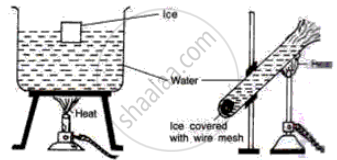
Study the following diagrams and write down your observations.
Advertisements
Solution

In the diagram, it is clear that the ice will melt faster in the flask than in the test tube because water is a bad conductor of heat and the transfer of heat in liquid through convection is from bottom to top.
APPEARS IN
RELATED QUESTIONS
Give reasons:
Water pipes burst in severe winters.
Describe an experiment to show that water has maximum density at 4°C. What important consequences follow this peculiar property of water? Discuss the importance of this phenomenon in nature.
Explain the following
A hollow glass sphere which floats with its entire volume submerged in water at 4°C, sinks when water is heated above 4°C.
Water is cooled from 4 °C to 0 °C. It will :
Density of water is maximum at :
What do you understand by the anomalous expansion of water?
Why does a thick glass tumbler crack when very hot water is poured in it?
Observe the given graph and answer the following questions:
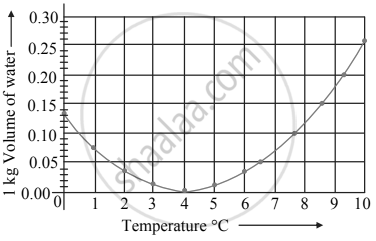
- Name the process represented in the figure.
- At what temperature does this process take place?
A graph between the volume and temperature of water is shown. Explain the anomalous behaviour of water.

