Advertisements
Advertisements
Question
Advertisements
Solution
Temperature in °C = 1°C
C/100 = (F-32)/180
F = 1 x 18/10 + 32
= 33.8°F
APPEARS IN
RELATED QUESTIONS
Give reason for Sea water does not freeze at 0°C.
Describe an experiment to show that water has maximum density at 4°C. What important consequences follow this peculiar property of water? Discuss the importance of this phenomenon in nature.
Explain, why are the exposed water pipes lagged with straw during severe winter?
Explain why do vegetables and fruits get damaged during severe frost?
In cold countries, the water pipes are covered with poor conductors. Why?
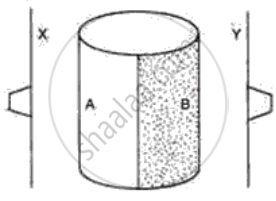
The following figure shows a metal cylinder, containing boiling water. One half side A is polished and another half, B is painted black. Two thin metal sheets X and Y are painted black and have one rubber stopper fixed with wax on each sheet. These sheets are equidistant from the boiling water (container A, B) as shown in the diagram. What would you expect to happen after a few minutes? Give a reason for your answer.
Write scientific reason.
Placing a plastic bottle filled with water in the freezing compartment in the freezer can cause the bottle to explode.
