Advertisements
Advertisements
Question
On a winter day the temperature of the tap water is 20°C whereas the room temperature is 5°C. Water is stored in a tank of capacity 0.5 m3 for household use. If it were possible to use the heat liberated by the water to lift a 10 kg mass vertically, how high can it be lifted as the water comes to the room temperature? Take g = 10 m s−2.
Advertisements
Solution
Given:-
Initial temperature of the water, Ti = 20°C
Final temperature of the water (room temperature), Tf = 5°C
Change in temeprature, ΔT = 20°C − 5°C = 15°C
Volume of water = 0.5 m3
Density of water, d = 1000 kg/m3
Mass of the water, M = (0.5 × 1000) kg = 500 kg
Heat liberated as the temperature of water changes from 20°C to 5°C is given by
Q = M×S×ΔT
Q = (500 × 4200 × 15) J
Q = (500 × 4200 × 15) J
Q = (75 × 420 × 1000) J
Q = 31500 × 1000 J = 315×105 J
Let the height to which the mass is lifted be h.
The energy required to lift the block = mgh = 10 × 10 × h = 100 h
Acording to the question,
Q = mgh
⇒ 100 h = 315×105 J
⇒ h = 315×103 m = 315 km
APPEARS IN
RELATED QUESTIONS
Give reason of Ice floats on water.
How does the anomalous expansion of water help aquatic organisms in cold climates?
What is the role of the anomalous behaviour of water in preserving aquatic life in regions of cold climate?
On what basis and how will you determine whether air is saturated with vapour or not?
Draw a graph to show the variation in density of water with temperature in the range from 0°C to 10°C.
Explain the following
A glass bottle completely filled with water and tightly closed at room temperature is likely to burst when kept in the freezer of a refrigerator.
What do you understand by the anomalous expansion of water?
Draw a graph between volume and temperature, when 5 cm3 of ice at -10°C is heated to form water at +10°C.
How do fishes survive in frozen lakes?
Explain, why are the exposed water pipes lagged with straw during severe winter?
Explain why do vegetables and fruits get damaged during severe frost?
What is the criterion of choosing the two metals for a bimetal strip?
Observe the given graph and answer the following questions:
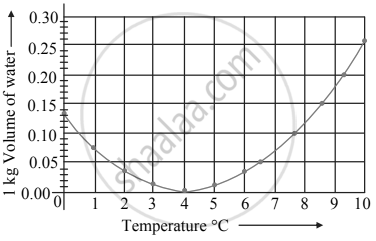
- Name the process represented in the figure.
- At what temperature does this process take place?
Write scientific reason.
Fish can survive even in frozen ponds in cold regions.
Write scientific reason.
Placing a plastic bottle filled with water in the freezing compartment in the freezer can cause the bottle to explode.
Observe the given picture and answer the following questions.
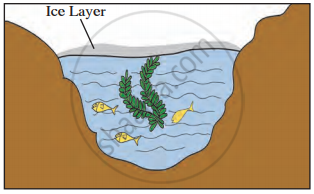
- Which property do you understand in this picture?
- What is the temperature of the water at the surface?
- What is the temperature below the layer of ice on the surface?
