Advertisements
Advertisements
Question
A 50 kg man is running at a speed of 18 km h−1. If all the kinetic energy of the man can be used to increase the temperature of water from 20°C to 30°C, how much water can be heated with this energy?
Advertisements
Solution
Given:-
Mass of the man, m = 50 kg
Speed of the man, v = 18 km/h = `18xx5/18=5"m/s"`
Kinetic energy of the man is given by
`K=1/2mV^2`
`K=(1/2)50xx5^2`
`K=25xx25=625 J`
Specific heat of the water, s = 4200 J/Kg-K
Let the mass of the water heated be M.
The amount of heat required to raise the temperature of water from 20°C to 30°C is given by
Q = msΔT = M × 4200 × (30 − 20)
Q = 42000 M
According to the question,
Q = K
42000 M = 625
`rArrM=625/42xx10^-3`
`=14.88xx10^-3`
=15 kg
APPEARS IN
RELATED QUESTIONS
Give reason of Ice floats on water.
Give reason for Sea water does not freeze at 0°C.
The amount of water vapour in air is determined in terms of its ______.
Observe the following graph. Considering the change in volume of water as its temperature is raised from 0°C, discuss the difference in the behaviour of water and other substances. What is this behaviour of water called?

What is the role of the anomalous behaviour of water in preserving aquatic life in regions of cold climate?
On what basis and how will you determine whether air is saturated with vapour or not?
1 kg of ice at 0°C is mixed with 1 kg of steam at 100°C. What will be the composition of the system when thermal equilibrium is reached? Latent heat of fusion of ice = 3.36 × 10³ J kg−1 and latent heat of vaporization of water = 2.26 × 10⁶ J kg−1.
Explain the following
Fishes survive in ponds even when the atmospheric temperature is well below 0°C.
In cold countries, the water pipes are covered with poor conductors. Why?
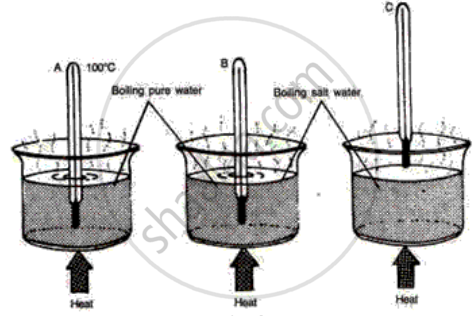
The following diagrams illustrate three situations involving thermometers which are labeled A, Band C. In each situation the thermometers indicate different readings.
(i) What do you expect the approximate reading of the thermometer B and C would be? Give a reason for your answer.
(ii) How would the readings of A and B help you in calibrating a thermometer?
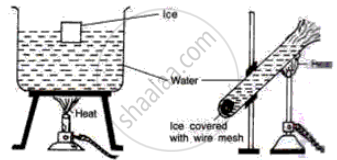
Study the following diagrams and write down your observations.
What is the criterion of choosing the two metals for a bimetal strip?
What will be the approximate temperature of water in the lake shown in the following diagram?
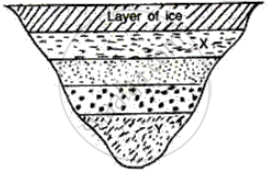
(i) At X, and
(ii) At Y?
Observe the given graph and answer the following questions:
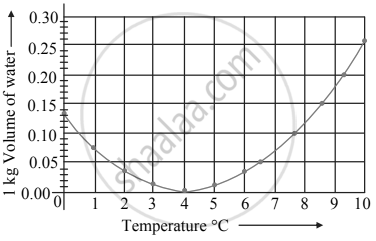
- Name the process represented in the figure.
- At what temperature does this process take place?
When the temperature of water decreases below 4 °C it’s volume _______.
Write scientific reason.
Placing a plastic bottle filled with water in the freezing compartment in the freezer can cause the bottle to explode.
