Advertisements
Advertisements
प्रश्न
A 50 kg man is running at a speed of 18 km h−1. If all the kinetic energy of the man can be used to increase the temperature of water from 20°C to 30°C, how much water can be heated with this energy?
Advertisements
उत्तर
Given:-
Mass of the man, m = 50 kg
Speed of the man, v = 18 km/h = `18xx5/18=5"m/s"`
Kinetic energy of the man is given by
`K=1/2mV^2`
`K=(1/2)50xx5^2`
`K=25xx25=625 J`
Specific heat of the water, s = 4200 J/Kg-K
Let the mass of the water heated be M.
The amount of heat required to raise the temperature of water from 20°C to 30°C is given by
Q = msΔT = M × 4200 × (30 − 20)
Q = 42000 M
According to the question,
Q = K
42000 M = 625
`rArrM=625/42xx10^-3`
`=14.88xx10^-3`
=15 kg
APPEARS IN
संबंधित प्रश्न
Water is used as a cooling agent.
Give reasons:
Water pipes burst in severe winters.
Observe the following graph. Considering the change in volume of water as its temperature is raised from 0°C, discuss the difference in the behaviour of water and other substances. What is this behaviour of water called?

Explain the following:
How can you relate the formation of water droplets on the outer surface of a bottle taken out of the refrigerator with the formation of dew?
1 kg of ice at 0°C is mixed with 1 kg of steam at 100°C. What will be the composition of the system when thermal equilibrium is reached? Latent heat of fusion of ice = 3.36 × 10³ J kg−1 and latent heat of vaporization of water = 2.26 × 10⁶ J kg−1.
Draw a graph between volume and temperature, when 5 cm3 of ice at -10°C is heated to form water at +10°C.
Explain, why does a glass bottle completely filled with water and tightly capped burst when placed in a freezer?
What are hot spots? How can you extract energy from a hot spot, if it does not come in contact with underground water?
What are land and sea breezes? Explain with the help of a labeled diagram.
What is the criterion of choosing the two metals for a bimetal strip?
Give reasons for the following:
Even when the water in the lakes is frozen, fish can survive.
What will be the approximate temperature of water in the lake shown in the following diagram?
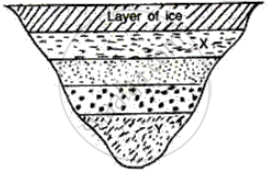
(i) At X, and
(ii) At Y?
While studying anomalous behaviour of water in Hope’s apparatus, the upper temperature of the thermometer : 0 °C : : lower temperature of the thermometer : _______
Write scientific reason.
Fish can survive even in frozen ponds in cold regions.
Match the columns:
| Column ‘A’ | Column ‘B’ |
| The density of water is maximum at | (a) 0°C |
| (b) 4°C | |
| (c) 100°C |
