Advertisements
Advertisements
प्रश्न
Advertisements
उत्तर
The cold air that blows from the land towards the sea during the night, is called a land breeze The cold air that blows from the sea towards the land during the day is known as the sea breeze. These breezes are examples of a natural convection current.

Natural convection currents
APPEARS IN
संबंधित प्रश्न
Explain the following:
How can you relate the formation of water droplets on the outer surface of a bottle taken out of the refrigerator with the formation of dew?
A calorimeter contains 50 g of water at 50°C. The temperature falls to 45°C in 10 minutes. When the calorimeter contains 100 g of water at 50°C, it takes 18 minutes for the temperature to become 45°C. Find the water equivalent of the calorimeter.
Explain, why does a glass bottle completely filled with water and tightly capped burst when placed in a freezer?
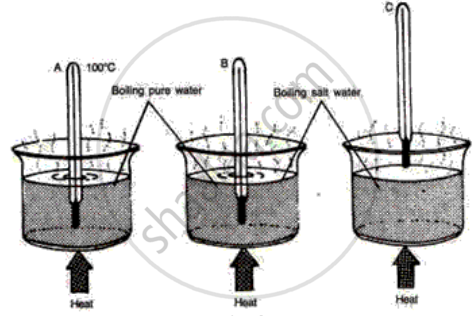
The following diagrams illustrate three situations involving thermometers which are labeled A, Band C. In each situation the thermometers indicate different readings.
(i) What do you expect the approximate reading of the thermometer B and C would be? Give a reason for your answer.
(ii) How would the readings of A and B help you in calibrating a thermometer?
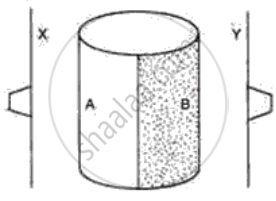
The following figure shows a metal cylinder, containing boiling water. One half side A is polished and another half, B is painted black. Two thin metal sheets X and Y are painted black and have one rubber stopper fixed with wax on each sheet. These sheets are equidistant from the boiling water (container A, B) as shown in the diagram. What would you expect to happen after a few minutes? Give a reason for your answer.
Give reasons for the following:
Even when the water in the lakes is frozen, fish can survive.
While studying anomalous behaviour of water in Hope’s apparatus, the upper temperature of the thermometer : 0 °C : : lower temperature of the thermometer : _______
Write a short note.
Anomalous behaviour of water
