मराठी

Why does a thick glass tumbler crack when very hot water is poured in it? - Physics

Advertisements
Advertisements

प्रश्न

Why does a thick glass tumbler crack when very hot water is poured in it?

टीपा लिहा
Advertisements

उत्तर

Why does a thick glass tumbler crack when very hot water is poured in it?

shaalaa.com
Anomalous Expansion of Water
  या प्रश्नात किंवा उत्तरात काही त्रुटी आहे का?
पाठ 5: Heat - Exercise [पृष्ठ २३०]

APPEARS IN

फ्रँक Physics [English] Class 9 ICSE
पाठ 5 Heat
Exercise | Q 36 | पृष्ठ २३०

संबंधित प्रश्‍न

A calorimeter contains 50 g of water at 50°C. The temperature falls to 45°C in 10 minutes. When the calorimeter contains 100 g of water at 50°C, it takes 18 minutes for the temperature to become 45°C. Find the water equivalent of the calorimeter.


Explain the following

A hollow glass sphere which floats with its entire volume submerged in water at 4°C, sinks when water is heated above 4°C.


Draw a graph between volume and temperature, when 5 cm3 of ice at -10°C is heated to form water at +10°C.


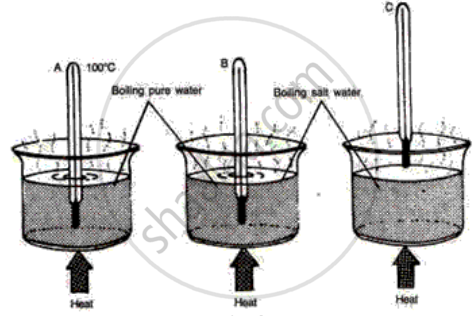
The following diagrams illustrate three situations involving thermometers which are labeled A, Band C. In each situation the thermometers indicate different readings.

(i) What do you expect the approximate reading of the thermometer B and C would be? Give a reason for your answer.
(ii) How would the readings of A and B help you in calibrating a thermometer?

The following figure shows a metal cylinder, containing boiling water. One half side A is polished and another half, B is painted black. Two thin metal sheets X and Y are painted black and have one rubber stopper fixed with wax on each sheet. These sheets are equidistant from the boiling water (container A, B) as shown in the diagram. What would you expect to happen after a few minutes? Give a reason for your answer.


Distinguish between Mercury and Alcohol as a thermometric liquid.

When the temperature of water decreases below 4 °C it’s volume _______.


In cold regions, in winter the pipes for water supply break.


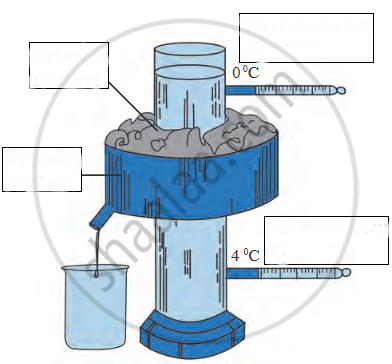
Observe the following diagram and write the answers to the questions given below.

  1. Which process does the graph represent?
  2. What is the range of temperature responsible for the behaviour?

Match the columns:

Column ‘A’ Column ‘B’
The density of water is maximum at (a) 0°C
  (b) 4°C
  (c) 100°C

Share
Notifications

Englishहिंदीमराठी


      Forgot password?
Use app×