Advertisements
Advertisements
प्रश्न
Advertisements
उत्तर
The cold air that blows from the land towards the sea during the night, is called a land breeze The cold air that blows from the sea towards the land during the day is known as the sea breeze. These breezes are examples of a natural convection current.

Natural convection currents
APPEARS IN
संबंधित प्रश्न
The amount of water vapour in air is determined in terms of its ______.
Observe the following graph. Considering the change in volume of water as its temperature is raised from 0°C, discuss the difference in the behaviour of water and other substances. What is this behaviour of water called?

1 kg of ice at 0°C is mixed with 1 kg of steam at 100°C. What will be the composition of the system when thermal equilibrium is reached? Latent heat of fusion of ice = 3.36 × 10³ J kg−1 and latent heat of vaporization of water = 2.26 × 10⁶ J kg−1.
Draw a graph to show the variation in density of water with temperature in the range from 0°C to 10°C.
In cold regions, in winter the pipes for water supply break.
Observe the following diagram and write the answers to the questions given below.
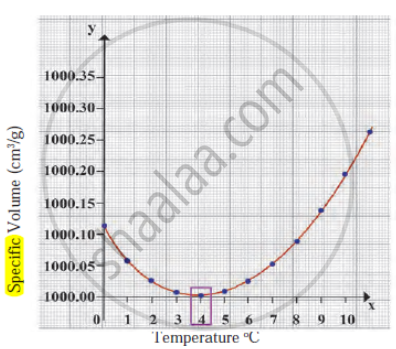
- Which process does the graph represent?
- What is the range of temperature responsible for the behaviour?
Name the following diagram appropriately.
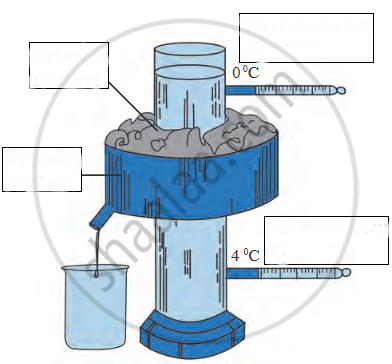
Write a short note.
Anomalous behaviour of water
