Advertisements
Advertisements
प्रश्न
Explain the following
Fishes survive in ponds even when the atmospheric temperature is well below 0°C.
Advertisements
उत्तर
The anomalous expansion of water helps preserve aquatic life during very cold weather. When temperature falls, the top layer of water in a pond contracts becomes denser and sinks to the bottom. A circulation is thus set up until water in the pond reaches its maximum density at 4°C. If the temperature falls further, then the top layer expands and remains on the top till it freezes. Thus, even though the upper layer are frozen, the water near the bottom is at 4°C and the fishes can survive in it easily.
APPEARS IN
संबंधित प्रश्न
Observe the following graph. Considering the change in volume of water as its temperature is raised from 0°C, discuss the difference in the behaviour of water and other substances. What is this behaviour of water called?

What do you mean by the anomalous expansion of water?
What are hot spots? How can you extract energy from a hot spot, if it does not come in contact with underground water?
In cold countries, the water pipes are covered with poor conductors. Why?
Why does a thick glass tumbler crack when very hot water is poured in it?
When the temperature of water decreases below 4 °C it’s volume _______.
_______ apparatus is used to study the anomalous behaviour of water.
Write scientific reason.
Placing a plastic bottle filled with water in the freezing compartment in the freezer can cause the bottle to explode.
Observe the given picture and answer the following questions.
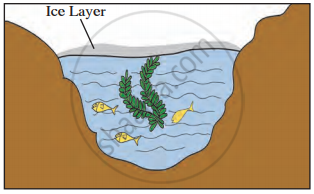
- Which property do you understand in this picture?
- What is the temperature of the water at the surface?
- What is the temperature below the layer of ice on the surface?
