Advertisements
Advertisements
प्रश्न
Explain the following
Fishes survive in ponds even when the atmospheric temperature is well below 0°C.
Advertisements
उत्तर
The anomalous expansion of water helps preserve aquatic life during very cold weather. When temperature falls, the top layer of water in a pond contracts becomes denser and sinks to the bottom. A circulation is thus set up until water in the pond reaches its maximum density at 4°C. If the temperature falls further, then the top layer expands and remains on the top till it freezes. Thus, even though the upper layer are frozen, the water near the bottom is at 4°C and the fishes can survive in it easily.
APPEARS IN
संबंधित प्रश्न
How does the anomalous expansion of water help aquatic organisms in cold climates?
Explain the following:
In cold regions in winter, the rocks crack due to anomalous expansion of water.
Calculate the time required to heat 20 kg of water from 10°C to 35°C using an immersion heater rated 1000 W. Assume that 80% of the power input is used to heat the water. Specific heat capacity of water = 42000 J kg−1 K−1.
Water is cooled from 4 °C to 0 °C. It will :
What do you understand by the anomalous expansion of water?
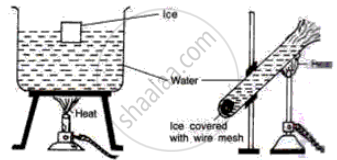
Study the following diagrams and write down your observations.
Give reasons for the following:
Even when the water in the lakes is frozen, fish can survive.
_______ apparatus is used to study the anomalous behaviour of water.
