Advertisements
Advertisements
प्रश्न
A calorimeter contains 50 g of water at 50°C. The temperature falls to 45°C in 10 minutes. When the calorimeter contains 100 g of water at 50°C, it takes 18 minutes for the temperature to become 45°C. Find the water equivalent of the calorimeter.
Advertisements
उत्तर
Let water equivalent to calorimeter be w.
Change in temperature = 5°C
Specific heat of water = 4200 J/Kg °C
Rate of flow of heat is given by
q = Energy per unit time = `(msDeltaT)/t`
Case 1:
`q_1 = ((w +50 xx 10^-3 )xx 4200xx5)/10`
Case 2
`q^2 = ((w+100 xx10^-3)xx 4200xx5)/18`
From calorimeter theory, these two rates of flow of heat should be equal to each other.
⇒ q1 = q2
`((w + 50 xx 10^-3)xx 4200xx5)/10 = ((w + 100xx10^-3)xx4200xx5)/18`
`rArr 18(W + 50 xx 10^-3) = 10(W + 100 xx10^-3)`
⇒ W = 12.5 ×10⁻³ kg
⇒ W = 12.5 g
APPEARS IN
संबंधित प्रश्न
On a winter day the temperature of the tap water is 20°C whereas the room temperature is 5°C. Water is stored in a tank of capacity 0.5 m3 for household use. If it were possible to use the heat liberated by the water to lift a 10 kg mass vertically, how high can it be lifted as the water comes to the room temperature? Take g = 10 m s−2.
What do you mean by the anomalous expansion of water?
Draw a graph to show the variation in density of water with temperature in the range from 0°C to 10°C.
Describe an experiment to show that water has maximum density at 4°C. What important consequences follow this peculiar property of water? Discuss the importance of this phenomenon in nature.
A deep pond of water has its top layer frozen. What will be the likely temperature of water layer at the bottom of the pond?
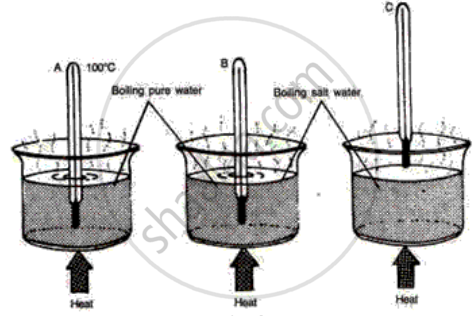
The following diagrams illustrate three situations involving thermometers which are labeled A, Band C. In each situation the thermometers indicate different readings.
(i) What do you expect the approximate reading of the thermometer B and C would be? Give a reason for your answer.
(ii) How would the readings of A and B help you in calibrating a thermometer?
What is the criterion of choosing the two metals for a bimetal strip?
Give reasons for the following:
Even when the water in the lakes is frozen, fish can survive.
Write the name.
The instrument used to study anomalous behaviour of water.
Write scientific reason.
Fish can survive even in frozen ponds in cold regions.
Observe the following diagram and write the answers to the questions given below.
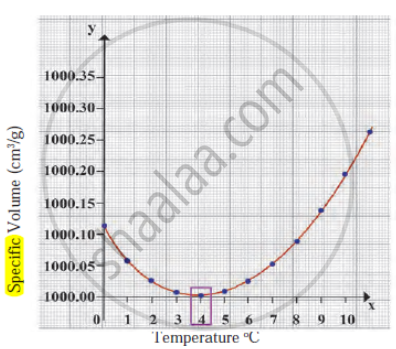
- Which process does the graph represent?
- What is the range of temperature responsible for the behaviour?
Write a short note.
Anomalous behaviour of water
Match the columns:
| Column ‘A’ | Column ‘B’ |
| The density of water is maximum at | (a) 0°C |
| (b) 4°C | |
| (c) 100°C |
