Advertisements
Advertisements
प्रश्न
Advertisements
उत्तर
Difference between mercury and alcohol as a thermometric substance
| Mercury | Alcohol |
| 1. It is non-volatile | It is volatile |
| 2. It has uniform expansion | It has non-uniform expansion |
| 3. It is opaque making it easier to read the thermometer | It is transparent thus making it difficult to read the thermometer |
| 4. It has a low coefficient of expansion | It has a high coefficient of expansion |
| 5. It has a high boiling point so it can be used to measure high temperatures | It has a low boiling point so it cannot be used to measure high temperatures |
APPEARS IN
संबंधित प्रश्न
On what basis and how will you determine whether air is saturated with vapour or not?
Explain the following
A glass bottle completely filled with water and tightly closed at room temperature is likely to burst when kept in the freezer of a refrigerator.
Draw a graph between volume and temperature, when 5 cm3 of ice at -10°C is heated to form water at +10°C.
Study the following diagrams and write down your observations.
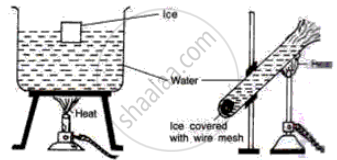
Give reasons for the following:
Even when the water in the lakes is frozen, fish can survive.
Observe the given graph and answer the following questions:
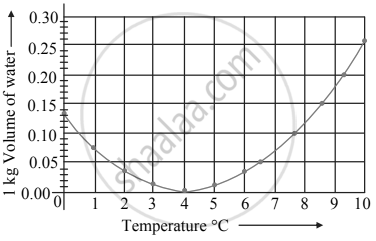
- Name the process represented in the figure.
- At what temperature does this process take place?
Write scientific reason.
Fish can survive even in frozen ponds in cold regions.
Observe the following diagram and write the answers to the questions given below.
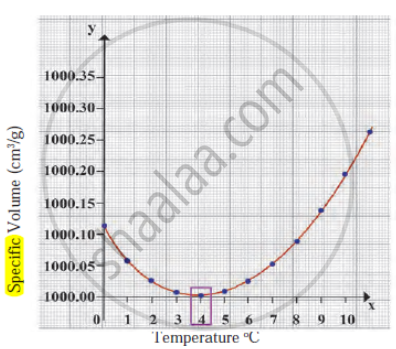
- Which process does the graph represent?
- What is the range of temperature responsible for the behaviour?
