Advertisements
Advertisements
प्रश्न
Advertisements
उत्तर
APPEARS IN
संबंधित प्रश्न
Give reason for Sea water does not freeze at 0°C.
On what basis and how will you determine whether air is saturated with vapour or not?
A calorimeter contains 50 g of water at 50°C. The temperature falls to 45°C in 10 minutes. When the calorimeter contains 100 g of water at 50°C, it takes 18 minutes for the temperature to become 45°C. Find the water equivalent of the calorimeter.
At what temperature is the density of water is maximum? State its value.
Draw a graph to show the variation in density of water with temperature in the range from 0°C to 10°C.
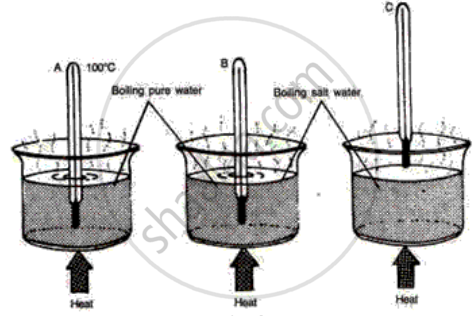
The following diagrams illustrate three situations involving thermometers which are labeled A, Band C. In each situation the thermometers indicate different readings.
(i) What do you expect the approximate reading of the thermometer B and C would be? Give a reason for your answer.
(ii) How would the readings of A and B help you in calibrating a thermometer?
In a region with a cold climate the aquatic animals can survive at 4 °C, because _______.
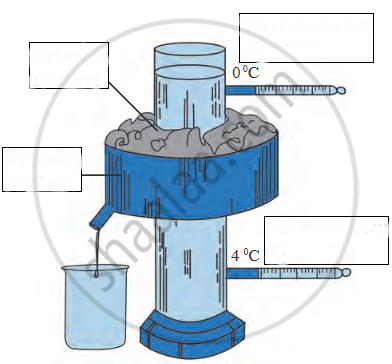
_______ apparatus is used to study the anomalous behaviour of water.
Name the following diagram appropriately.
Match the columns:
| Column ‘A’ | Column ‘B’ |
| The density of water is maximum at | (a) 0°C |
| (b) 4°C | |
| (c) 100°C |
