Advertisements
Advertisements
प्रश्न
Advertisements
उत्तर
Fill a round bottom flask with a coloured liquid up to the brim. Fit it with a one holed cork and pass a narrow glass tube through it. Mark the level of the liquid in the glass tube. Place the flask in a water bath and heat the bath.
You will see that the level of liquid water rises in the glass tube. This is due to the expansion of the liquid on heating.

APPEARS IN
संबंधित प्रश्न
On what basis and how will you determine whether air is saturated with vapour or not?
On a winter day the temperature of the tap water is 20°C whereas the room temperature is 5°C. Water is stored in a tank of capacity 0.5 m3 for household use. If it were possible to use the heat liberated by the water to lift a 10 kg mass vertically, how high can it be lifted as the water comes to the room temperature? Take g = 10 m s−2.
A 50 kg man is running at a speed of 18 km h−1. If all the kinetic energy of the man can be used to increase the temperature of water from 20°C to 30°C, how much water can be heated with this energy?
What do you understand by the anomalous expansion of water?
Observe the given graph and answer the following questions:
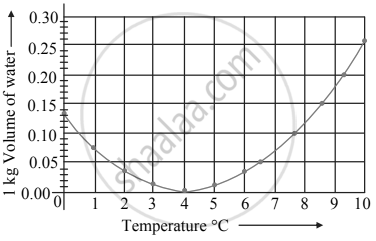
- Name the process represented in the figure.
- At what temperature does this process take place?
In a region with a cold climate the aquatic animals can survive at 4 °C, because _______.
Write the name.
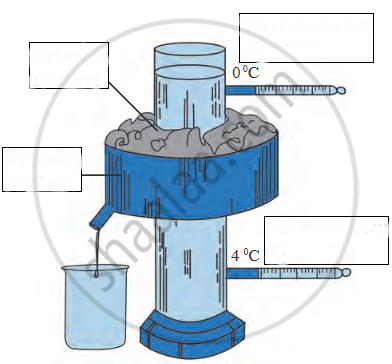
The instrument used to study anomalous behaviour of water.
Observe the following diagram and write the answers to the questions given below.
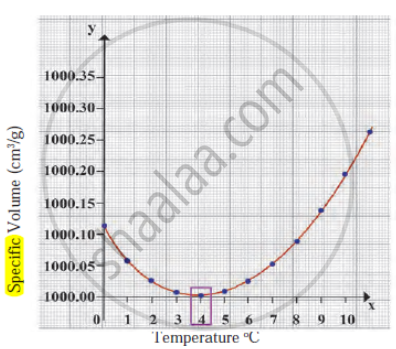
- Which process does the graph represent?
- What is the range of temperature responsible for the behaviour?
Name the following diagram appropriately.