Advertisements
Advertisements
प्रश्न
Advertisements
उत्तर
Take a round bottom flask which is filled with air and closed with a one holed rubber cork. A narrow capillary tube is passed through the cork and the flask is supported on a tripod in an inverted position as shown in the figure, so that the end of the capillary tube is underwater. Now, heat the flask gently with a spirit lamp. You will observe bubbles coming out from the capillary tube. This shows that gases expand on heating.

APPEARS IN
संबंधित प्रश्न
Calculate the time required to heat 20 kg of water from 10°C to 35°C using an immersion heater rated 1000 W. Assume that 80% of the power input is used to heat the water. Specific heat capacity of water = 42000 J kg−1 K−1.
On a winter day the temperature of the tap water is 20°C whereas the room temperature is 5°C. Water is stored in a tank of capacity 0.5 m3 for household use. If it were possible to use the heat liberated by the water to lift a 10 kg mass vertically, how high can it be lifted as the water comes to the room temperature? Take g = 10 m s−2.
Water is cooled from 4 °C to 0 °C. It will :
Density of water is maximum at :
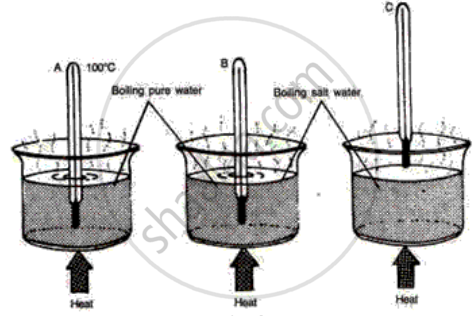
The following diagrams illustrate three situations involving thermometers which are labeled A, Band C. In each situation the thermometers indicate different readings.
(i) What do you expect the approximate reading of the thermometer B and C would be? Give a reason for your answer.
(ii) How would the readings of A and B help you in calibrating a thermometer?
_______ apparatus is used to study the anomalous behaviour of water.
Write scientific reason.
Fish can survive even in frozen ponds in cold regions.
