Advertisements
Advertisements
प्रश्न
Consider the situation of the previous problem. Assume that the temperature of the water at the bottom of the lake remains constant at 4°C as the ice forms on the surface (the heat required to maintain the temperature of the bottom layer may come from the bed of the lake). The depth of the lake is 1.0 m. Show that the thickness of the ice formed attains a steady state maximum value. Find this value. The thermal conductivity of water = 0.50 W m−1°C−1. Take other relevant data from the previous problem.
Advertisements
उत्तर
Let the point upto which ice is formed is at a distance of x m from the top of the lake.
Under steady state, the rate of flow of heat from ice to this point should be equal to the rate flow of heat from water to this point.
Temperature of the top layer of ice = −10°C
Temperature of water at the bottom of the lake = 4°C
Temperature at the point upto which ice is formed = `((DeltaQ)/(Deltat))_{ice} = ((DeltaQ)/(Deltat))_{water}`
`k_{ice}/(x/(Axx10)`= `K_{water}/((1-x)/(Axx4)`
`(1.7 xx 10)/x = (0.5xx4)/(1-x)`
`(1.7)/x = (0.5xx4)/(1-x)`
17 - 17x = 2x
`⇒ x =17/19 = 0.89 m`
`⇒ x = 89 cm`
APPEARS IN
संबंधित प्रश्न
How does the anomalous expansion of water help aquatic organisms in cold climates?
Observe the following graph. Considering the change in volume of water as its temperature is raised from 0°C, discuss the difference in the behaviour of water and other substances. What is this behaviour of water called?

Explain the following:
How can you relate the formation of water droplets on the outer surface of a bottle taken out of the refrigerator with the formation of dew?
What do you mean by the anomalous expansion of water?
Explain the following
A glass bottle completely filled with water and tightly closed at room temperature is likely to burst when kept in the freezer of a refrigerator.
Draw a graph between volume and temperature, when 5 cm3 of ice at -10°C is heated to form water at +10°C.
Explain, why are soft drink bottles not completely filled?
What are hot spots? How can you extract energy from a hot spot, if it does not come in contact with underground water?
In cold countries, the water pipes are covered with poor conductors. Why?
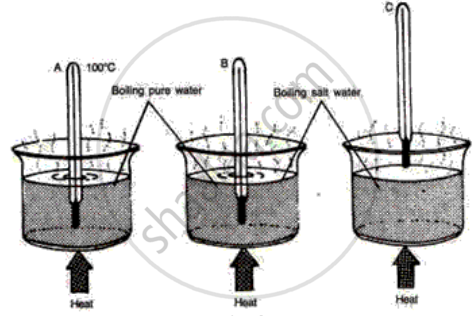
The following diagrams illustrate three situations involving thermometers which are labeled A, Band C. In each situation the thermometers indicate different readings.
(i) What do you expect the approximate reading of the thermometer B and C would be? Give a reason for your answer.
(ii) How would the readings of A and B help you in calibrating a thermometer?
What will be the approximate temperature of water in the lake shown in the following diagram?
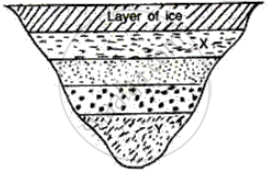
(i) At X, and
(ii) At Y?
Observe the given graph and answer the following questions:
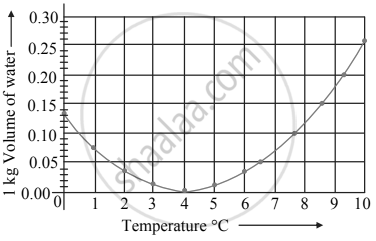
- Name the process represented in the figure.
- At what temperature does this process take place?
While studying anomalous behaviour of water in Hope’s apparatus, the upper temperature of the thermometer : 0 °C : : lower temperature of the thermometer : _______
Write the name.
The instrument used to study anomalous behaviour of water.
