Advertisements
Advertisements
Question
Consider the situation of the previous problem. Assume that the temperature of the water at the bottom of the lake remains constant at 4°C as the ice forms on the surface (the heat required to maintain the temperature of the bottom layer may come from the bed of the lake). The depth of the lake is 1.0 m. Show that the thickness of the ice formed attains a steady state maximum value. Find this value. The thermal conductivity of water = 0.50 W m−1°C−1. Take other relevant data from the previous problem.
Advertisements
Solution
Let the point upto which ice is formed is at a distance of x m from the top of the lake.
Under steady state, the rate of flow of heat from ice to this point should be equal to the rate flow of heat from water to this point.
Temperature of the top layer of ice = −10°C
Temperature of water at the bottom of the lake = 4°C
Temperature at the point upto which ice is formed = `((DeltaQ)/(Deltat))_{ice} = ((DeltaQ)/(Deltat))_{water}`
`k_{ice}/(x/(Axx10)`= `K_{water}/((1-x)/(Axx4)`
`(1.7 xx 10)/x = (0.5xx4)/(1-x)`
`(1.7)/x = (0.5xx4)/(1-x)`
17 - 17x = 2x
`⇒ x =17/19 = 0.89 m`
`⇒ x = 89 cm`
APPEARS IN
RELATED QUESTIONS
How does the anomalous expansion of water help aquatic organisms in cold climates?
A 50 kg man is running at a speed of 18 km h−1. If all the kinetic energy of the man can be used to increase the temperature of water from 20°C to 30°C, how much water can be heated with this energy?
What do you mean by the anomalous expansion of water?
At what temperature is the density of water is maximum? State its value.
Explain the following
Fishes survive in ponds even when the atmospheric temperature is well below 0°C.
Density of water is maximum at :
How do fishes survive in frozen lakes?
Explain, why are soft drink bottles not completely filled?
Explain, why does a glass bottle completely filled with water and tightly capped burst when placed in a freezer?
A deep pond of water has its top layer frozen. What will be the likely temperature of water layer just in contact with ice?
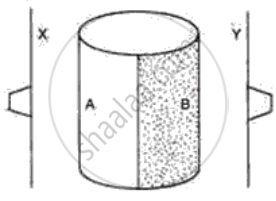
The following figure shows a metal cylinder, containing boiling water. One half side A is polished and another half, B is painted black. Two thin metal sheets X and Y are painted black and have one rubber stopper fixed with wax on each sheet. These sheets are equidistant from the boiling water (container A, B) as shown in the diagram. What would you expect to happen after a few minutes? Give a reason for your answer.
When the temperature of water decreases below 4 °C it’s volume _______.
In cold regions, in winter the pipes for water supply break.
Draw a neat and labelled diagram of Hope’s apparatus.
A graph between the volume and temperature of water is shown. Explain the anomalous behaviour of water.

