Advertisements
Advertisements
प्रश्न
Consider the situation of the previous problem. Assume that the temperature of the water at the bottom of the lake remains constant at 4°C as the ice forms on the surface (the heat required to maintain the temperature of the bottom layer may come from the bed of the lake). The depth of the lake is 1.0 m. Show that the thickness of the ice formed attains a steady state maximum value. Find this value. The thermal conductivity of water = 0.50 W m−1°C−1. Take other relevant data from the previous problem.
Advertisements
उत्तर
Let the point upto which ice is formed is at a distance of x m from the top of the lake.
Under steady state, the rate of flow of heat from ice to this point should be equal to the rate flow of heat from water to this point.
Temperature of the top layer of ice = −10°C
Temperature of water at the bottom of the lake = 4°C
Temperature at the point upto which ice is formed = `((DeltaQ)/(Deltat))_{ice} = ((DeltaQ)/(Deltat))_{water}`
`k_{ice}/(x/(Axx10)`= `K_{water}/((1-x)/(Axx4)`
`(1.7 xx 10)/x = (0.5xx4)/(1-x)`
`(1.7)/x = (0.5xx4)/(1-x)`
17 - 17x = 2x
`⇒ x =17/19 = 0.89 m`
`⇒ x = 89 cm`
APPEARS IN
संबंधित प्रश्न
The amount of water vapour in air is determined in terms of its ______.
What is the role of the anomalous behaviour of water in preserving aquatic life in regions of cold climate?
Explain the following
Fishes survive in ponds even when the atmospheric temperature is well below 0°C.
Explain the following
A glass bottle completely filled with water and tightly closed at room temperature is likely to burst when kept in the freezer of a refrigerator.
Explain, why are soft drink bottles not completely filled?
Explain, why are the exposed water pipes lagged with straw during severe winter?
What are hot spots? How can you extract energy from a hot spot, if it does not come in contact with underground water?
What are land and sea breezes? Explain with the help of a labeled diagram.
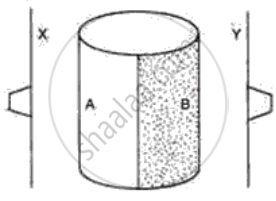
The following figure shows a metal cylinder, containing boiling water. One half side A is polished and another half, B is painted black. Two thin metal sheets X and Y are painted black and have one rubber stopper fixed with wax on each sheet. These sheets are equidistant from the boiling water (container A, B) as shown in the diagram. What would you expect to happen after a few minutes? Give a reason for your answer.
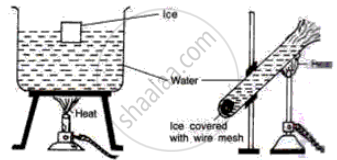
Study the following diagrams and write down your observations.
What will be the approximate temperature of water in the lake shown in the following diagram?
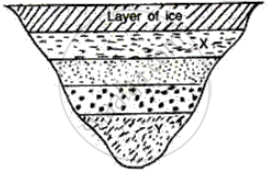
(i) At X, and
(ii) At Y?
Write scientific reason.
Placing a plastic bottle filled with water in the freezing compartment in the freezer can cause the bottle to explode.
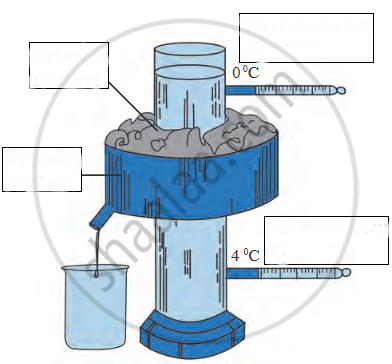
Draw a neat and labelled diagram of Hope’s apparatus.
Name the following diagram appropriately.
A graph between the volume and temperature of water is shown. Explain the anomalous behaviour of water.

