Advertisements
Advertisements
प्रश्न
On a winter day the temperature of the tap water is 20°C whereas the room temperature is 5°C. Water is stored in a tank of capacity 0.5 m3 for household use. If it were possible to use the heat liberated by the water to lift a 10 kg mass vertically, how high can it be lifted as the water comes to the room temperature? Take g = 10 m s−2.
Advertisements
उत्तर
Given:-
Initial temperature of the water, Ti = 20°C
Final temperature of the water (room temperature), Tf = 5°C
Change in temeprature, ΔT = 20°C − 5°C = 15°C
Volume of water = 0.5 m3
Density of water, d = 1000 kg/m3
Mass of the water, M = (0.5 × 1000) kg = 500 kg
Heat liberated as the temperature of water changes from 20°C to 5°C is given by
Q = M×S×ΔT
Q = (500 × 4200 × 15) J
Q = (500 × 4200 × 15) J
Q = (75 × 420 × 1000) J
Q = 31500 × 1000 J = 315×105 J
Let the height to which the mass is lifted be h.
The energy required to lift the block = mgh = 10 × 10 × h = 100 h
Acording to the question,
Q = mgh
⇒ 100 h = 315×105 J
⇒ h = 315×103 m = 315 km
APPEARS IN
संबंधित प्रश्न
Give reasons:
Water pipes burst in severe winters.
Give reason for Sea water does not freeze at 0°C.
Observe the following graph. Considering the change in volume of water as its temperature is raised from 0°C, discuss the difference in the behaviour of water and other substances. What is this behaviour of water called?

1 kg of ice at 0°C is mixed with 1 kg of steam at 100°C. What will be the composition of the system when thermal equilibrium is reached? Latent heat of fusion of ice = 3.36 × 10³ J kg−1 and latent heat of vaporization of water = 2.26 × 10⁶ J kg−1.
A calorimeter contains 50 g of water at 50°C. The temperature falls to 45°C in 10 minutes. When the calorimeter contains 100 g of water at 50°C, it takes 18 minutes for the temperature to become 45°C. Find the water equivalent of the calorimeter.
At what temperature is the density of water is maximum? State its value.
Explain the following
Fishes survive in ponds even when the atmospheric temperature is well below 0°C.
Water is cooled from 4 °C to 0 °C. It will :
Density of water is maximum at :
Draw a graph between volume and temperature, when 5 cm3 of ice at -10°C is heated to form water at +10°C.
Explain, why are the exposed water pipes lagged with straw during severe winter?
Why does a thick glass tumbler crack when very hot water is poured in it?
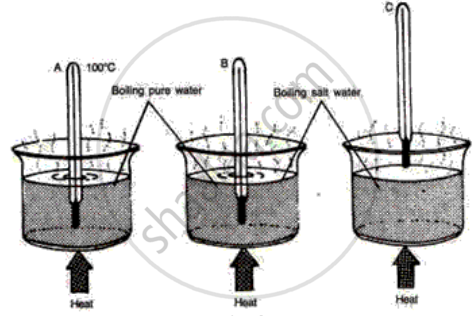
The following diagrams illustrate three situations involving thermometers which are labeled A, Band C. In each situation the thermometers indicate different readings.
(i) What do you expect the approximate reading of the thermometer B and C would be? Give a reason for your answer.
(ii) How would the readings of A and B help you in calibrating a thermometer?
In cold regions, in winter the pipes for water supply break.
Write a short note.
Anomalous behaviour of water
Match the columns:
| Column ‘A’ | Column ‘B’ |
| The density of water is maximum at | (a) 0°C |
| (b) 4°C | |
| (c) 100°C |
