Advertisements
Advertisements
प्रश्न
Calculate the time required to heat 20 kg of water from 10°C to 35°C using an immersion heater rated 1000 W. Assume that 80% of the power input is used to heat the water. Specific heat capacity of water = 42000 J kg−1 K−1.
Advertisements
उत्तर
Given:-
Power rating of the immersion rod, P = 1000 W
Specific heat of water, S = 4200 J kg−1 K−1
Mass of water, M = 20 kg
Change in temperature, ΔT = 25 °C
Total heat required to raise the temperature of 20 kg of water from 10°C to 35°C is given by
Q = M × S × ΔT
Q = 20 × 4200 × 25
Q = 20 × 4200 × 25 = 21 × 105 J
Let the time taken to heat 20 kg of water from 10°C to 35°C be t. Only 80% of the immersion rod's heat is useful for heating water. Thus,
Energy of the immersion rod utilised for heating the water = t × (0.80) × 1000 J
t × (0.80) × 1000 J = 21 × 105 J
`t=(21xx10^5)/800=2625s`
`rArrt=2625/60=43.75minapprox44min`
APPEARS IN
संबंधित प्रश्न
Give reason of Ice floats on water.
How does the anomalous expansion of water help aquatic organisms in cold climates?
What is the role of the anomalous behaviour of water in preserving aquatic life in regions of cold climate?
Explain the following:
How can you relate the formation of water droplets on the outer surface of a bottle taken out of the refrigerator with the formation of dew?
On a winter day the temperature of the tap water is 20°C whereas the room temperature is 5°C. Water is stored in a tank of capacity 0.5 m3 for household use. If it were possible to use the heat liberated by the water to lift a 10 kg mass vertically, how high can it be lifted as the water comes to the room temperature? Take g = 10 m s−2.
Explain the following
Fishes survive in ponds even when the atmospheric temperature is well below 0°C.
Explain the following
A hollow glass sphere which floats with its entire volume submerged in water at 4°C, sinks when water is heated above 4°C.
Explain the following
A glass bottle completely filled with water and tightly closed at room temperature is likely to burst when kept in the freezer of a refrigerator.
Explain, why does a glass bottle completely filled with water and tightly capped burst when placed in a freezer?
What is the criterion of choosing the two metals for a bimetal strip?
Give reasons for the following:
Even when the water in the lakes is frozen, fish can survive.
What will be the approximate temperature of water in the lake shown in the following diagram?
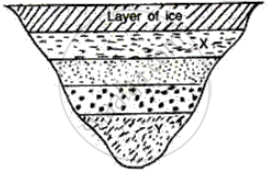
(i) At X, and
(ii) At Y?
Draw a neat and labelled diagram of Hope’s apparatus.
Observe the following diagram and write the answers to the questions given below.
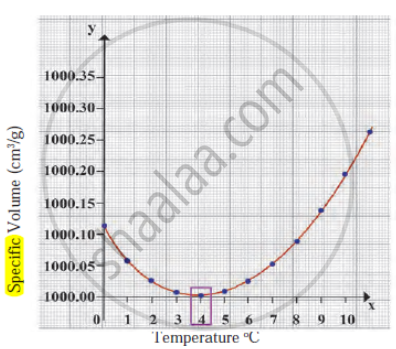
- Which process does the graph represent?
- What is the range of temperature responsible for the behaviour?
Name the following diagram appropriately.
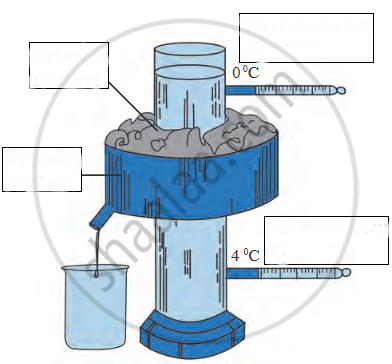
Write a short note.
Anomalous behaviour of water
