Advertisements
Advertisements
प्रश्न
1 kg of ice at 0°C is mixed with 1 kg of steam at 100°C. What will be the composition of the system when thermal equilibrium is reached? Latent heat of fusion of ice = 3.36 × 10³ J kg−1 and latent heat of vaporization of water = 2.26 × 10⁶ J kg−1.
Advertisements
उत्तर
Given:-
Amount of ice at 0oC = 1 kg
Amount of steam at 100oC = 1 kg
Latent heat of fusion of ice = 3.36 × 10³ J kg−1
Latent heat of vapourisation of water = 2.26 × 10⁶ J kg−1
We can observe that the latent heat of fusion of ice (3.36 × 10⁵ J kg−1) is smaller that latent heat of vapouisation of water (2.26 × 10⁶ ). Therefore, ice will first change into water as less heat is required for this and there will be equilibrium between steam and water.
Heat absorbed by the ice when it changes into water (Q1) = 1×(3.36 × 105) J
Heat absorbed by the water formed to change its temperature from 0oC to 100oC (Q2) = 1 × 4200 × 100 = 4.2 × 10⁵ J
Total heat absorbed by the ice to raise the temperature to 100°C, Q = Q1+Q2 = 3.36 × 10⁵+ 4.2 × 105 = (3.36 + 4.2) × 105 = 7.56 × 10⁵ J
The heat required to change ice into water at 100oC is supplied by the steam. This heat will be released by the steam and will then change into water.
If all the steam gets converted into water, heat released by steam, Q' = 1 ×( 2.26 × 10⁶) J = 2.26 × 10⁶ J
Amount of heat released is more than that required by the ice to get converted into water at 100oC. Thus,
Extra heat = Q − Q'
= (2.26 − 0.756) × 106
= 1.506 × 10⁶
Let the mass of steam that is condensed into water be m. Thus,
`m=(7.56xx10^5)/(2.26xx10^6)=0.335kg=335gm`
Total amount of water at 100°C = 1000 + 335 = 1335 g =1.335 g
Steam left = 1− 0.335 = 0.665 kg = 665 gm
APPEARS IN
संबंधित प्रश्न
Water is used as a cooling agent.
Give reasons:
Water pipes burst in severe winters.
How does the anomalous expansion of water help aquatic organisms in cold climates?
The amount of water vapour in air is determined in terms of its ______.
On what basis and how will you determine whether air is saturated with vapour or not?
On a winter day the temperature of the tap water is 20°C whereas the room temperature is 5°C. Water is stored in a tank of capacity 0.5 m3 for household use. If it were possible to use the heat liberated by the water to lift a 10 kg mass vertically, how high can it be lifted as the water comes to the room temperature? Take g = 10 m s−2.
A 50 kg man is running at a speed of 18 km h−1. If all the kinetic energy of the man can be used to increase the temperature of water from 20°C to 30°C, how much water can be heated with this energy?
Water is cooled from 4 °C to 0 °C. It will :
Draw a graph between volume and temperature, when 5 cm3 of ice at -10°C is heated to form water at +10°C.
What are land and sea breezes? Explain with the help of a labeled diagram.
In cold countries, the water pipes are covered with poor conductors. Why?
What is the criterion of choosing the two metals for a bimetal strip?
Write the name.
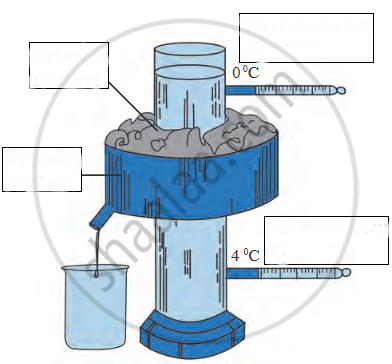
The instrument used to study anomalous behaviour of water.
Write scientific reason.
Placing a plastic bottle filled with water in the freezing compartment in the freezer can cause the bottle to explode.
Observe the following diagram and write the answers to the questions given below.
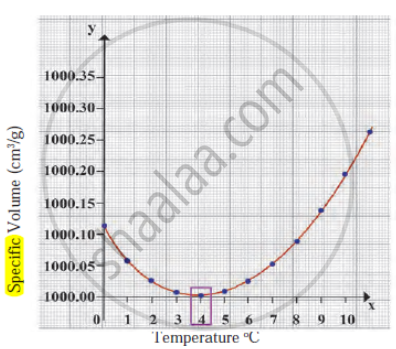
- Which process does the graph represent?
- What is the range of temperature responsible for the behaviour?
Name the following diagram appropriately.
Match the columns:
| Column ‘A’ | Column ‘B’ |
| The density of water is maximum at | (a) 0°C |
| (b) 4°C | |
| (c) 100°C |
