Advertisements
Advertisements
प्रश्न
Advertisements
उत्तर
Fill a round bottom flask with a coloured liquid up to the brim. Fit it with a one holed cork and pass a narrow glass tube through it. Mark the level of the liquid in the glass tube. Place the flask in a water bath and heat the bath.
You will see that the level of liquid water rises in the glass tube. This is due to the expansion of the liquid on heating.

APPEARS IN
संबंधित प्रश्न
Consider the situation of the previous problem. Assume that the temperature of the water at the bottom of the lake remains constant at 4°C as the ice forms on the surface (the heat required to maintain the temperature of the bottom layer may come from the bed of the lake). The depth of the lake is 1.0 m. Show that the thickness of the ice formed attains a steady state maximum value. Find this value. The thermal conductivity of water = 0.50 W m−1°C−1. Take other relevant data from the previous problem.
What do you mean by the anomalous expansion of water?
Draw a graph to show the variation in density of water with temperature in the range from 0°C to 10°C.
Explain the following
A glass bottle completely filled with water and tightly closed at room temperature is likely to burst when kept in the freezer of a refrigerator.
What do you understand by the anomalous expansion of water?
Draw a graph between volume and temperature, when 5 cm3 of ice at -10°C is heated to form water at +10°C.
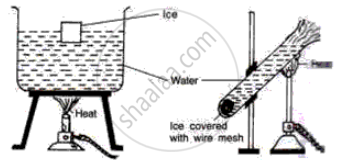
Study the following diagrams and write down your observations.
Give reasons for the following:
Even when the water in the lakes is frozen, fish can survive.
