Advertisements
Advertisements
Question
Calculate the time required to heat 20 kg of water from 10°C to 35°C using an immersion heater rated 1000 W. Assume that 80% of the power input is used to heat the water. Specific heat capacity of water = 42000 J kg−1 K−1.
Advertisements
Solution
Given:-
Power rating of the immersion rod, P = 1000 W
Specific heat of water, S = 4200 J kg−1 K−1
Mass of water, M = 20 kg
Change in temperature, ΔT = 25 °C
Total heat required to raise the temperature of 20 kg of water from 10°C to 35°C is given by
Q = M × S × ΔT
Q = 20 × 4200 × 25
Q = 20 × 4200 × 25 = 21 × 105 J
Let the time taken to heat 20 kg of water from 10°C to 35°C be t. Only 80% of the immersion rod's heat is useful for heating water. Thus,
Energy of the immersion rod utilised for heating the water = t × (0.80) × 1000 J
t × (0.80) × 1000 J = 21 × 105 J
`t=(21xx10^5)/800=2625s`
`rArrt=2625/60=43.75minapprox44min`
APPEARS IN
RELATED QUESTIONS
Water is used as a cooling agent.
How does the anomalous expansion of water help aquatic organisms in cold climates?
A 50 kg man is running at a speed of 18 km h−1. If all the kinetic energy of the man can be used to increase the temperature of water from 20°C to 30°C, how much water can be heated with this energy?
What do you mean by the anomalous expansion of water?
At what temperature is the density of water is maximum? State its value.
Describe an experiment to show that water has maximum density at 4°C. What important consequences follow this peculiar property of water? Discuss the importance of this phenomenon in nature.
Water is cooled from 4 °C to 0 °C. It will :
In cold countries, the water pipes are covered with poor conductors. Why?
Why does a thick glass tumbler crack when very hot water is poured in it?
What will be the approximate temperature of water in the lake shown in the following diagram?
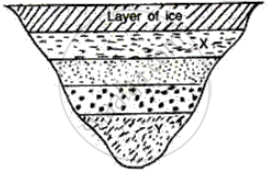
(i) At X, and
(ii) At Y?
Observe the given graph and answer the following questions:
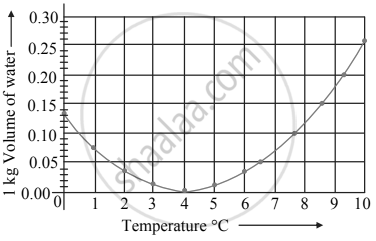
- Name the process represented in the figure.
- At what temperature does this process take place?
When the temperature of water decreases below 4 °C it’s volume _______.
_______ apparatus is used to study the anomalous behaviour of water.
Write the name.
The instrument used to study anomalous behaviour of water.
Write scientific reason.
Fish can survive even in frozen ponds in cold regions.
Observe the following diagram and write the answers to the questions given below.
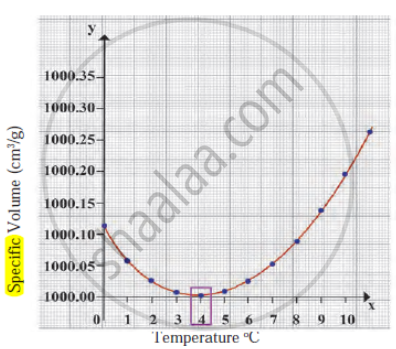
- Which process does the graph represent?
- What is the range of temperature responsible for the behaviour?
