Advertisements
Advertisements
Question
Advertisements
Solution
Take a round bottom flask which is filled with air and closed with a one holed rubber cork. A narrow capillary tube is passed through the cork and the flask is supported on a tripod in an inverted position as shown in the figure, so that the end of the capillary tube is underwater. Now, heat the flask gently with a spirit lamp. You will observe bubbles coming out from the capillary tube. This shows that gases expand on heating.

APPEARS IN
RELATED QUESTIONS
How does the anomalous expansion of water help aquatic organisms in cold climates?
At what temperature is the density of water is maximum? State its value.
Draw a graph to show the variation in density of water with temperature in the range from 0°C to 10°C.
Density of water is maximum at :
What are hot spots? How can you extract energy from a hot spot, if it does not come in contact with underground water?
Study the following diagrams and write down your observations.
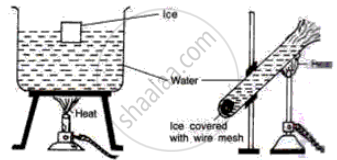
Observe the following diagram and write the answers to the questions given below.
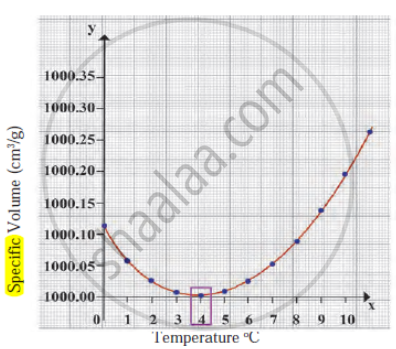
- Which process does the graph represent?
- What is the range of temperature responsible for the behaviour?
