Advertisements
Advertisements
Question
What will be the approximate temperature of water in the lake shown in the following diagram?
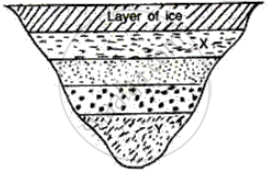
(i) At X, and
(ii) At Y?
Advertisements
Solution

The layer at the top level is ice so its temperature is therefore 0°C and temperature at every layer of water below ice increases by 1°C
(i) At X = 1°C since it is the first layer below the ice
(ii) At Y = 4°C since it is the fourth layer below ice
APPEARS IN
RELATED QUESTIONS
How does the anomalous expansion of water help aquatic organisms in cold climates?
What is the role of the anomalous behaviour of water in preserving aquatic life in regions of cold climate?
1 kg of ice at 0°C is mixed with 1 kg of steam at 100°C. What will be the composition of the system when thermal equilibrium is reached? Latent heat of fusion of ice = 3.36 × 10³ J kg−1 and latent heat of vaporization of water = 2.26 × 10⁶ J kg−1.
What do you mean by the anomalous expansion of water?
Density of water is maximum at :
What are hot spots? How can you extract energy from a hot spot, if it does not come in contact with underground water?
In cold countries, the water pipes are covered with poor conductors. Why?
Write scientific reason.
Fish can survive even in frozen ponds in cold regions.
