Advertisements
Advertisements
Question
Give reasons for the following:
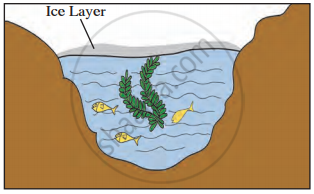
Even when the water in the lakes is frozen, fish can survive.
Advertisements
Solution
Even when the water in the lakes is frozen, fishes can survive due to anomalous expansion of water, water has maximum density at 4°C and this dense water remains at the bottom of the lake and the upper layer of water is less dense and freezes but the temperature of each layer of water below increases by 1°C. Thus it is warmer in the lakes below the ice layer. This helps the fishes to survive.C and this dense water remains at the bottom of the lake and the upper layer of water is less dense and freezes but the temperature of each layer of water below increases by 1°C. Thus it is warmer in the lakes below the ice layer. This helps the fishes to survive.
APPEARS IN
RELATED QUESTIONS
What do you mean by the anomalous expansion of water?
Explain the following
Fishes survive in ponds even when the atmospheric temperature is well below 0°C.
Water is cooled from 4 °C to 0 °C. It will :
Explain, why are the exposed water pipes lagged with straw during severe winter?
Observe the given picture and answer the following questions.
- Which property do you understand in this picture?
- What is the temperature of the water at the surface?
- What is the temperature below the layer of ice on the surface?
