Advertisements
Advertisements
Question
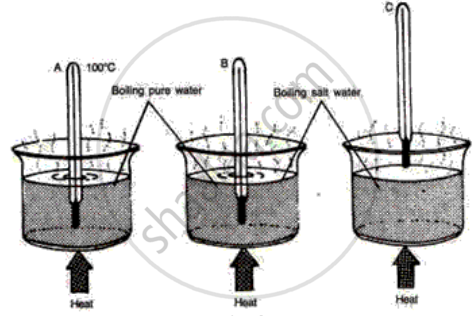
The following diagrams illustrate three situations involving thermometers which are labeled A, Band C. In each situation the thermometers indicate different readings.
(i) What do you expect the approximate reading of the thermometer B and C would be? Give a reason for your answer.
(ii) How would the readings of A and B help you in calibrating a thermometer?
Advertisements
Solution
(i) The temperature of steam and boiling water Is equal so the reading of thermometer is the same. But due to the addition of salt boiling point of water elevates so the reading of thermometer would be slightly higher than the boiling point of water i.e 100° C.
(ii) The addition of salt boiling point of water increases so thermometer has to measure temperature for a wider range and thus it helps in the calibration of the thermometer.
APPEARS IN
RELATED QUESTIONS
Give reason of Ice floats on water.
Give reason for Sea water does not freeze at 0°C.
How does the anomalous expansion of water help aquatic organisms in cold climates?
On what basis and how will you determine whether air is saturated with vapour or not?
On a winter day the temperature of the tap water is 20°C whereas the room temperature is 5°C. Water is stored in a tank of capacity 0.5 m3 for household use. If it were possible to use the heat liberated by the water to lift a 10 kg mass vertically, how high can it be lifted as the water comes to the room temperature? Take g = 10 m s−2.
Explain why do vegetables and fruits get damaged during severe frost?
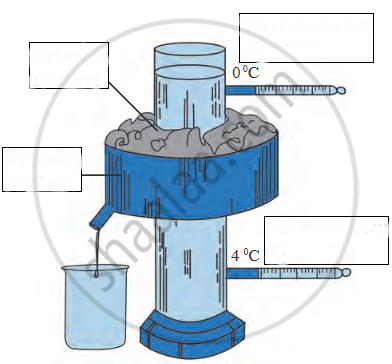
Name the following diagram appropriately.
Observe the given picture and answer the following questions.
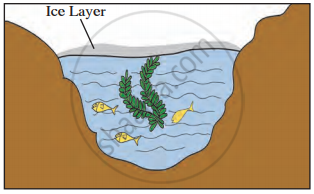
- Which property do you understand in this picture?
- What is the temperature of the water at the surface?
- What is the temperature below the layer of ice on the surface?
