Advertisements
Advertisements
प्रश्न
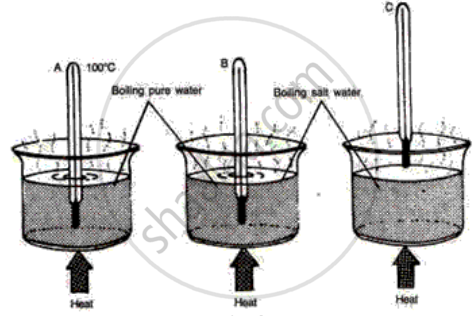
The following diagrams illustrate three situations involving thermometers which are labeled A, Band C. In each situation the thermometers indicate different readings.
(i) What do you expect the approximate reading of the thermometer B and C would be? Give a reason for your answer.
(ii) How would the readings of A and B help you in calibrating a thermometer?
Advertisements
उत्तर
(i) The temperature of steam and boiling water Is equal so the reading of thermometer is the same. But due to the addition of salt boiling point of water elevates so the reading of thermometer would be slightly higher than the boiling point of water i.e 100° C.
(ii) The addition of salt boiling point of water increases so thermometer has to measure temperature for a wider range and thus it helps in the calibration of the thermometer.
APPEARS IN
संबंधित प्रश्न
Water is used as a cooling agent.
A 50 kg man is running at a speed of 18 km h−1. If all the kinetic energy of the man can be used to increase the temperature of water from 20°C to 30°C, how much water can be heated with this energy?
A calorimeter contains 50 g of water at 50°C. The temperature falls to 45°C in 10 minutes. When the calorimeter contains 100 g of water at 50°C, it takes 18 minutes for the temperature to become 45°C. Find the water equivalent of the calorimeter.
At what temperature is the density of water is maximum? State its value.
Explain the following
A hollow glass sphere which floats with its entire volume submerged in water at 4°C, sinks when water is heated above 4°C.
Draw a graph between volume and temperature, when 5 cm3 of ice at -10°C is heated to form water at +10°C.
Explain why do vegetables and fruits get damaged during severe frost?
What are land and sea breezes? Explain with the help of a labeled diagram.
What will be the approximate temperature of water in the lake shown in the following diagram?
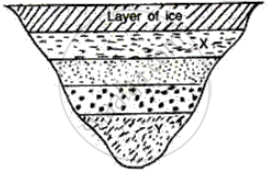
(i) At X, and
(ii) At Y?
Observe the given graph and answer the following questions:
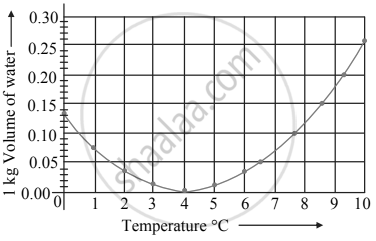
- Name the process represented in the figure.
- At what temperature does this process take place?
