Advertisements
Advertisements
Question
The diagram shows a sketch graph showing a change in volume of a given mass of ice at -5°C to water at 15°C.
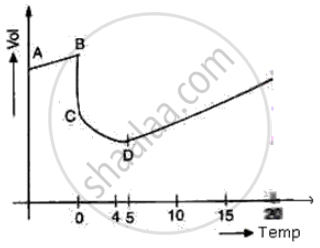
(i) Why does the temperature along BC remain constant?
(ii) When is the volume of water minimum?
(iii) At what temperature does water have maximum density? Explain.
Advertisements
Solution
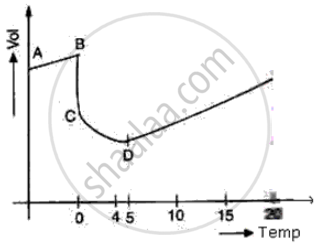
(i) At BC temperature is constant because at 0°C all of the heat given is used in the process of formation of water from ice and no part of the heat is used in changing the temperature of ice.
(ii) At point D i.e. at 4°C the volume of water is minimum
(iii) At point D i.e. at 4°C, the density of water is maximum due to anomalous expansion of water in the temperature range of 0°C and 4°C as volume decreases, the density of water increases
APPEARS IN
RELATED QUESTIONS
A cubical metal solid block is heated. How will its volume change?
An empty glass bottle is fitted with a narrow tube at its mouth. The open end of the tube is kept in a beaker containing water. When the bottle is heated, bubbles of air are seen escaping into water. Explain the reason.
An iron washer is heated. State the effect on its external.
An iron washer is heated. State the effect on its internal diameter.
What is the velocity of thermal radiations?
Distinguish between a clinical and a laboratory thermometer.
Define the following term:
Coefficient of superficial expansion
Give reasons for the following:
In cold countries, water pipes burst in winter.
Analogy:
Ordinary glass:: Glass tumbler.
Pyrex glass:: ______.
