Advertisements
Advertisements
Question
Advertisements
Solution
Take a ball and ring apparatus as shown in figure. At room temperature, the ball can just pass through the ring. Now heat the ball over a flame and try to pass it through the ring. You will find that the ball when heated is not able to pass through the ring. The diameter of the ball increases when the ball is heated. This shows the expansion of solid on heating.

APPEARS IN
RELATED QUESTIONS
What is matter? What is it composed of?
Describe an experiment to showthat air expands on heating.
Define the following term:
Coefficient of cubical expansion
The diagram shows a sketch graph showing a change in volume of a given mass of ice at -5°C to water at 15°C.
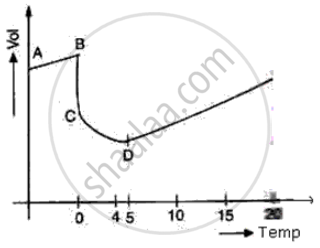
(i) Why does the temperature along BC remain constant?
(ii) When is the volume of water minimum?
(iii) At what temperature does water have maximum density? Explain.
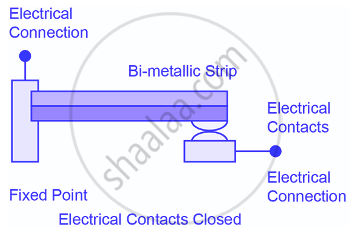
A bimetal strip is shown in the below diagram before heating. Draw a diagram to show how it bends on heating and on cooling.
Thermal expansion is always a nuisance.
What difference do you think heating the solid will make in their molecules?
If you heat a circular disk with a hole, what change do you expect in the diameter of the hole? Remember that the effect of heating increases the separation between any pair of particles.
Analogy:
Expansion is length:: Linear expansion.
Expansion in volume:: ______.
What type of glassware is used in laboratories? Why?
