Advertisements
Advertisements
प्रश्न
What are hot spots? How can you extract energy from a hot spot, if it does not come in contact with underground water?
Advertisements
उत्तर
Hot spots: The places under the surface of earth, where hot magma collects at fairly less depths, are called hot spots of the earth.
If hot spot does not come in contact with underground water then two holes are made in the earth’s crust. Through one hole is pumped in cold water. The cold water on coming in contact with the hot spot changes to super heated steam, which emerges out from the other hole. The steam is then made to run a turbine coupled with generator to produce electricity.
संबंधित प्रश्न
On what basis and how will you determine whether air is saturated with vapour or not?
Consider the situation of the previous problem. Assume that the temperature of the water at the bottom of the lake remains constant at 4°C as the ice forms on the surface (the heat required to maintain the temperature of the bottom layer may come from the bed of the lake). The depth of the lake is 1.0 m. Show that the thickness of the ice formed attains a steady state maximum value. Find this value. The thermal conductivity of water = 0.50 W m−1°C−1. Take other relevant data from the previous problem.
What are land and sea breezes? Explain with the help of a labeled diagram.
In cold countries, the water pipes are covered with poor conductors. Why?
In a region with a cold climate the aquatic animals can survive at 4 °C, because _______.
While studying anomalous behaviour of water in Hope’s apparatus, the upper temperature of the thermometer : 0 °C : : lower temperature of the thermometer : _______
Write the name.
The instrument used to study anomalous behaviour of water.
Observe the given picture and answer the following questions.
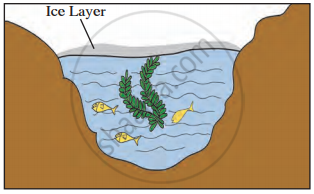
- Which property do you understand in this picture?
- What is the temperature of the water at the surface?
- What is the temperature below the layer of ice on the surface?
