Advertisements
Advertisements
प्रश्न
Advertisements
उत्तर
Lower fixed point = 10°C
Upper fixed point =130°C
Range of thermometer= 130°C - 10°C
= 120°C
No of divisions = 100
So least count = 120/100 = 1.2°C
On actual thermometer 40°C would have 40 divisions
So, on this thermometer, it would show
= 40 x LC = 48°C
APPEARS IN
संबंधित प्रश्न
Describe an experiment to show that water has maximum density at 4°C. What important consequences follow this peculiar property of water? Discuss the importance of this phenomenon in nature.
Explain the following
A hollow glass sphere which floats with its entire volume submerged in water at 4°C, sinks when water is heated above 4°C.
Draw a graph between volume and temperature, when 5 cm3 of ice at -10°C is heated to form water at +10°C.
The following figure shows a metal cylinder, containing boiling water. One half side A is polished and another half, B is painted black. Two thin metal sheets X and Y are painted black and have one rubber stopper fixed with wax on each sheet. These sheets are equidistant from the boiling water (container A, B) as shown in the diagram. What would you expect to happen after a few minutes? Give a reason for your answer.
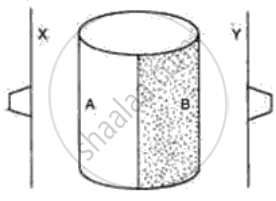
Observe the following diagram and write the answers to the questions given below.
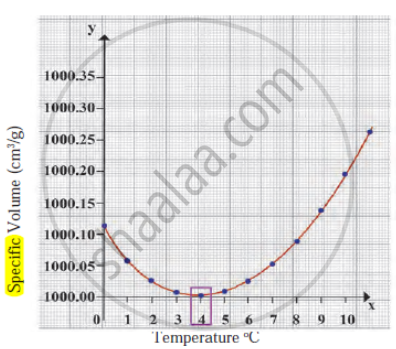
- Which process does the graph represent?
- What is the range of temperature responsible for the behaviour?
Write a short note.
Anomalous behaviour of water
Match the columns:
| Column ‘A’ | Column ‘B’ |
| The density of water is maximum at | (a) 0°C |
| (b) 4°C | |
| (c) 100°C |
