Advertisements
Advertisements
प्रश्न
Advertisements
उत्तर
Temperature in °C = 1°C
C/100 = (F-32)/180
F = 1 x 18/10 + 32
= 33.8°F
APPEARS IN
संबंधित प्रश्न
Water is used as a cooling agent.
Explain the following:
In cold regions in winter, the rocks crack due to anomalous expansion of water.
Calculate the time required to heat 20 kg of water from 10°C to 35°C using an immersion heater rated 1000 W. Assume that 80% of the power input is used to heat the water. Specific heat capacity of water = 42000 J kg−1 K−1.
On a winter day the temperature of the tap water is 20°C whereas the room temperature is 5°C. Water is stored in a tank of capacity 0.5 m3 for household use. If it were possible to use the heat liberated by the water to lift a 10 kg mass vertically, how high can it be lifted as the water comes to the room temperature? Take g = 10 m s−2.
A 50 kg man is running at a speed of 18 km h−1. If all the kinetic energy of the man can be used to increase the temperature of water from 20°C to 30°C, how much water can be heated with this energy?
A deep pond of water has its top layer frozen. What will be the likely temperature of water layer just in contact with ice?
In cold countries, the water pipes are covered with poor conductors. Why?
Write the name.
The instrument used to study anomalous behaviour of water.
Write a short note.
Anomalous behaviour of water
Observe the given picture and answer the following questions.
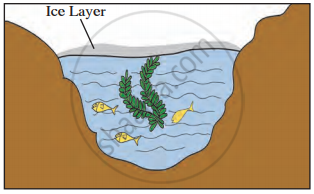
- Which property do you understand in this picture?
- What is the temperature of the water at the surface?
- What is the temperature below the layer of ice on the surface?
