Advertisements
Advertisements
Question
A calorimeter contains 50 g of water at 50°C. The temperature falls to 45°C in 10 minutes. When the calorimeter contains 100 g of water at 50°C, it takes 18 minutes for the temperature to become 45°C. Find the water equivalent of the calorimeter.
Advertisements
Solution
Let water equivalent to calorimeter be w.
Change in temperature = 5°C
Specific heat of water = 4200 J/Kg °C
Rate of flow of heat is given by
q = Energy per unit time = `(msDeltaT)/t`
Case 1:
`q_1 = ((w +50 xx 10^-3 )xx 4200xx5)/10`
Case 2
`q^2 = ((w+100 xx10^-3)xx 4200xx5)/18`
From calorimeter theory, these two rates of flow of heat should be equal to each other.
⇒ q1 = q2
`((w + 50 xx 10^-3)xx 4200xx5)/10 = ((w + 100xx10^-3)xx4200xx5)/18`
`rArr 18(W + 50 xx 10^-3) = 10(W + 100 xx10^-3)`
⇒ W = 12.5 ×10⁻³ kg
⇒ W = 12.5 g
APPEARS IN
RELATED QUESTIONS
Water is used as a cooling agent.
Give reason for Sea water does not freeze at 0°C.
Explain the following:
How can you relate the formation of water droplets on the outer surface of a bottle taken out of the refrigerator with the formation of dew?
1 kg of ice at 0°C is mixed with 1 kg of steam at 100°C. What will be the composition of the system when thermal equilibrium is reached? Latent heat of fusion of ice = 3.36 × 10³ J kg−1 and latent heat of vaporization of water = 2.26 × 10⁶ J kg−1.
Consider the situation of the previous problem. Assume that the temperature of the water at the bottom of the lake remains constant at 4°C as the ice forms on the surface (the heat required to maintain the temperature of the bottom layer may come from the bed of the lake). The depth of the lake is 1.0 m. Show that the thickness of the ice formed attains a steady state maximum value. Find this value. The thermal conductivity of water = 0.50 W m−1°C−1. Take other relevant data from the previous problem.
Explain, why are soft drink bottles not completely filled?
Explain why do vegetables and fruits get damaged during severe frost?
What are land and sea breezes? Explain with the help of a labeled diagram.
Why does a thick glass tumbler crack when very hot water is poured in it?
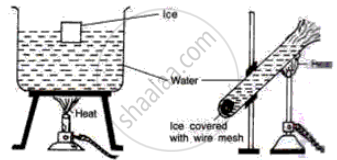
Study the following diagrams and write down your observations.
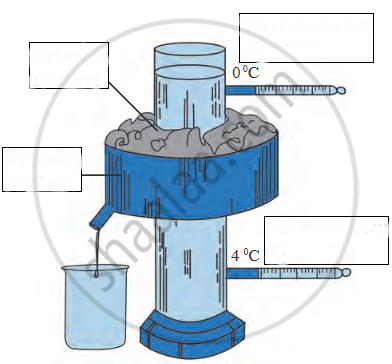
_______ apparatus is used to study the anomalous behaviour of water.
Write the name.
The instrument used to study anomalous behaviour of water.
In cold regions, in winter the pipes for water supply break.
Draw a neat and labelled diagram of Hope’s apparatus.
Name the following diagram appropriately.