Advertisements
Advertisements
Question
How does the anomalous expansion of water help aquatic organisms in cold climates?
Advertisements
Solution 1
The anomalous expansion of water helps in the survival of water animals in very cold climates. Initially when the temperature of waterfalls, becomes heavier and sinks down. This process continues till 4°C. Then after this expansion takes place. The surface layer of water gets freezed. Ice being a bad conductor of heat does not allow loss of heat from the water below and results in the survival of water animals.
Solution 2
When water is cooled it contracts and its density, increases until the temperature reaches 4°C, on further cooling water starts expanding with decrease in its density. This is anomalous phenomenon. The aquatic organisms can live there easily.
APPEARS IN
RELATED QUESTIONS
Give reason for Sea water does not freeze at 0°C.
Consider the situation of the previous problem. Assume that the temperature of the water at the bottom of the lake remains constant at 4°C as the ice forms on the surface (the heat required to maintain the temperature of the bottom layer may come from the bed of the lake). The depth of the lake is 1.0 m. Show that the thickness of the ice formed attains a steady state maximum value. Find this value. The thermal conductivity of water = 0.50 W m−1°C−1. Take other relevant data from the previous problem.
Explain the following
A hollow glass sphere which floats with its entire volume submerged in water at 4°C, sinks when water is heated above 4°C.
Explain, why are the exposed water pipes lagged with straw during severe winter?
What will be the approximate temperature of water in the lake shown in the following diagram?
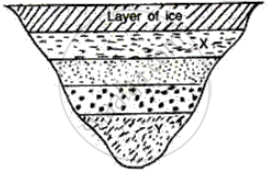
(i) At X, and
(ii) At Y?
Write the name.
The instrument used to study anomalous behaviour of water.
Observe the following diagram and write the answers to the questions given below.
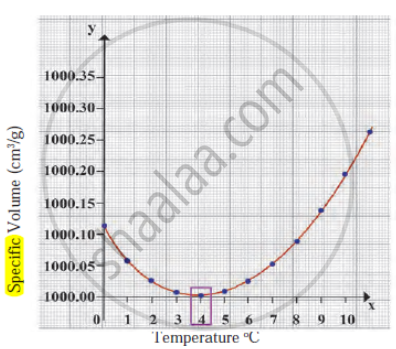
- Which process does the graph represent?
- What is the range of temperature responsible for the behaviour?
