Advertisements
Advertisements
प्रश्न
How does the anomalous expansion of water help aquatic organisms in cold climates?
Advertisements
उत्तर १
The anomalous expansion of water helps in the survival of water animals in very cold climates. Initially when the temperature of waterfalls, becomes heavier and sinks down. This process continues till 4°C. Then after this expansion takes place. The surface layer of water gets freezed. Ice being a bad conductor of heat does not allow loss of heat from the water below and results in the survival of water animals.
उत्तर २
When water is cooled it contracts and its density, increases until the temperature reaches 4°C, on further cooling water starts expanding with decrease in its density. This is anomalous phenomenon. The aquatic organisms can live there easily.
APPEARS IN
संबंधित प्रश्न
On a winter day the temperature of the tap water is 20°C whereas the room temperature is 5°C. Water is stored in a tank of capacity 0.5 m3 for household use. If it were possible to use the heat liberated by the water to lift a 10 kg mass vertically, how high can it be lifted as the water comes to the room temperature? Take g = 10 m s−2.
Consider the situation of the previous problem. Assume that the temperature of the water at the bottom of the lake remains constant at 4°C as the ice forms on the surface (the heat required to maintain the temperature of the bottom layer may come from the bed of the lake). The depth of the lake is 1.0 m. Show that the thickness of the ice formed attains a steady state maximum value. Find this value. The thermal conductivity of water = 0.50 W m−1°C−1. Take other relevant data from the previous problem.
What do you mean by the anomalous expansion of water?
Draw a graph between volume and temperature, when 5 cm3 of ice at -10°C is heated to form water at +10°C.
Explain why do vegetables and fruits get damaged during severe frost?
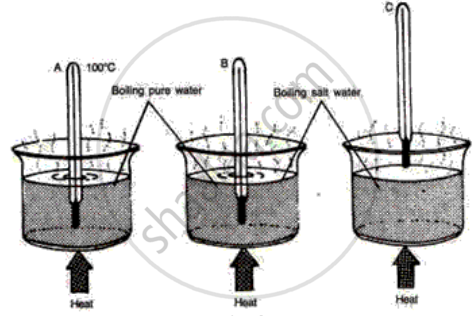
The following diagrams illustrate three situations involving thermometers which are labeled A, Band C. In each situation the thermometers indicate different readings.
(i) What do you expect the approximate reading of the thermometer B and C would be? Give a reason for your answer.
(ii) How would the readings of A and B help you in calibrating a thermometer?
What will be the approximate temperature of water in the lake shown in the following diagram?
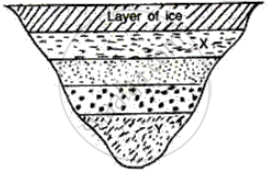
(i) At X, and
(ii) At Y?
When the temperature of water decreases below 4 °C it’s volume _______.
