Advertisements
Advertisements
प्रश्न
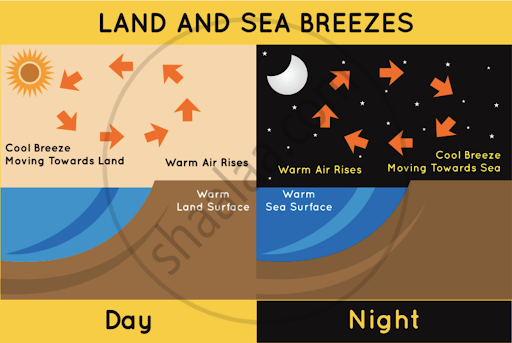
What are land and sea breezes? Explain with the help of a labeled diagram.
Advertisements
उत्तर
The cold air that blows from the land towards the sea during night, is called a land breeze. The cold air that blows from the sea towards the land during the day is known as the sea breeze. These breezes are examples of a natural convection current.
APPEARS IN
संबंधित प्रश्न
Give reason for Sea water does not freeze at 0°C.
How does the anomalous expansion of water help aquatic organisms in cold climates?
On a winter day the temperature of the tap water is 20°C whereas the room temperature is 5°C. Water is stored in a tank of capacity 0.5 m3 for household use. If it were possible to use the heat liberated by the water to lift a 10 kg mass vertically, how high can it be lifted as the water comes to the room temperature? Take g = 10 m s−2.
A calorimeter contains 50 g of water at 50°C. The temperature falls to 45°C in 10 minutes. When the calorimeter contains 100 g of water at 50°C, it takes 18 minutes for the temperature to become 45°C. Find the water equivalent of the calorimeter.
A deep pond of water has its top layer frozen. What will be the likely temperature of water layer just in contact with ice?
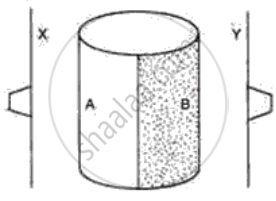
The following figure shows a metal cylinder, containing boiling water. One half side A is polished and another half, B is painted black. Two thin metal sheets X and Y are painted black and have one rubber stopper fixed with wax on each sheet. These sheets are equidistant from the boiling water (container A, B) as shown in the diagram. What would you expect to happen after a few minutes? Give a reason for your answer.
_______ apparatus is used to study the anomalous behaviour of water.
