Advertisements
Advertisements
प्रश्न
Explain the following
A hollow glass sphere which floats with its entire volume submerged in water at 4°C, sinks when water is heated above 4°C.
टिप्पणी लिखिए
Advertisements
उत्तर
On heating water above 4°C, the density of water decreases. As a result, the upthrust acting due to water on hollow glass sphere also decreases, which causes it to sink.
shaalaa.com
Anomalous Expansion of Water
क्या इस प्रश्न या उत्तर में कोई त्रुटि है?
APPEARS IN
संबंधित प्रश्न
How does the anomalous expansion of water help aquatic organisms in cold climates?
Explain, why are the exposed water pipes lagged with straw during severe winter?
What are hot spots? How can you extract energy from a hot spot, if it does not come in contact with underground water?
Write a short note on Land Breeze and Sea Breeze.
The temperature of two bodies A and B differ by 1°C. By how much will it differ on a Fahrenheit scale?
Explain the 'anomalous expansion' of water.
What properties of water slow down the complete freezing of the water in the lake?
What will be the approximate temperature of water in the lake shown in the following diagram?
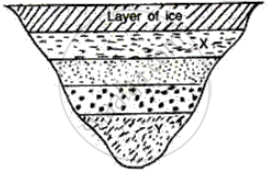
(i) At X, and
(ii) At Y?
Name two substances which expand on heating.
Match the columns:
| Column ‘A’ | Column ‘B’ |
| The density of water is maximum at | (a) 0°C |
| (b) 4°C | |
| (c) 100°C |
