Advertisements
Advertisements
प्रश्न
(i) Calculate the height of a water column which will exert on its base the same
Pressure as the 70 cm column of mercury.
(ii) Will the height of the water column change if the cross-section of the water column is made wider?
Advertisements
उत्तर
(i) we know pressure exerted by a liquid column of height h, density p is P = h x px g.
The pressure exerted by a mercury column of height 70 cm.
Density of mercury = 13.6 g/cc = 1.36 x 10⁴kg/m3.
Pmercury = 0.7 x 1.36 x 104 x 9.8 = 9.32 x 10⁴ Nm-2.
Let the height of the water column = hm.
Density of water = 1g/cc = 103 kg/m3.
Pwater = h x 103 x 9.8 = 9.8h x 103 Nm-2,
Now put Pmercury = Pwater
9.8 h x 103 = 9.32 x 10⁴
h = 93.2/9.8 = 9.52 m.
So, 9.52 m height of water column would exert the same pressure on its base as 70 cm column of mercury.
(ii) The height of the water column would not change if the cross-section of the water column is made wider.
APPEARS IN
संबंधित प्रश्न
What is the pressure exerted by 75 cm vertical column of mercury of density 13600 kgm−3 in SI units?
[Take g = 9.8 ms−2].
Pressure at the bottom of the sea at some particular place is 8968960 Pa. If the density of seawater is 1040 kgm3 calculate the depth of the sea. Take g = 9.8 ms−2. Neglect the pressure of the atmosphere.
Calculate the equivalent height of mercury, which will exert as much pressure as 960 m of seawater of density 1040 kgm−3. The density of mercury is 13600 kgm−3.
The pressure of water on the ground floor, in a water pipe is 150000 Pa, whereas pressure on the fourth floor is 30000 Pa. Calculate the height of the fourth floor. Take g = 10 ms−2.
The normal pressure of air is 76 cm of mercury. Calculate the pressure in SI units.
[Density of mercury = 13600 kg/m3 and g = 10 m/s2]
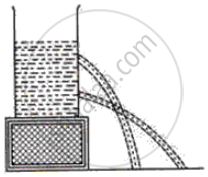
What fact about liquid pressure does the following diagram in the following figure illustrate?