Advertisements
Advertisements
प्रश्न
An object thrown vertically upwards reaches a height of 500 m. What was its initial velocity? How long will the object take to come back to the earth? Assume g = 10 m/s2.
Advertisements
उत्तर
From newton’s third equation of motion,
V2 = u2 + 2as
Where:
V = Final velocity;
U = initial velocity;
T = time taken;
S = distance travelled;
A = acceleration;
According to our question,
The figure below illustrates the situation given in the question
V = 0 (Velocity at maximum height is zero);
S = 500 m;
A = −10 m/s2 (because when the object is going up, the acceleration due to gravity will be acting downwards to make the object fall). Hence by sign convention direction of motion and acceleration is opposite (therefore, a is negative);
Putting the above values we get
02 = u2 + (2 x (−10) x 500)
0 = u2 − 10000
u2 = 10000
⇒ u = `sqrt10000` = 100
Therefore, the initial velocity is 100 m/s.
From the first equation of motion,
v = u + at
Where symbols have there usual meanings as above;
v = 0 (velocity at maximum height is zero);
u = initial velocity = 100 m/s;
a = −10 m/s2 (because when the object is going up, the acceleration due to gravity will be acting downwards to make the object fall). Hence by sign convention direction of motion and acceleration is opposite (therefore, a is negative);
Putting the values we get.
0 = 100 + (−10t)
= 100 = 10t
t = `100/10` = 10s
Now we know that time required by an object to go up is the same as time required to come down.
Therefore,
Total time = time of ascent + time of descent
= 10 + 10 = 20 s
Hence, the total time to come back to earth is 20 seconds.
APPEARS IN
संबंधित प्रश्न
What do you mean by free fall?
Gravitational force acts on all objects in proportion to their masses. Why then, a heavy object does not fall faster than a light object?
A ball is thrown vertically upwards with a velocity of 49 m/s. Calculate
- the maximum height to which it rises.
- the total time it takes to return to the surface of the earth.
A stone is released from the top of a tower of height 19.6 m. Calculate its final velocity just before touching the ground.
Which force is responsible for the moon revolving round the earth ?
State whether the following statement is true or false :
A falling stone also attracts the earth.
What is the force of gravity on a body of mass 150 kg lying on the surface of the earth? (Mass of earth = 6 x 1024 kg; Radius of earth = 6.4 x 10⁶ m; G = 6.7 x 10⁻¹¹ Nm2/kg2)
Explain why, a wide steel belt is provided over the wheels of an army tank.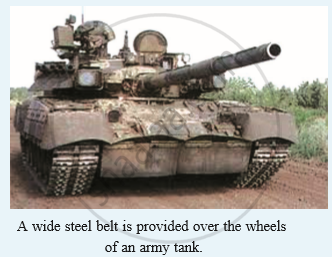
A stone is thrown vertically upwards with initial velocity u reaches a height ‘h’ before coming down. Show that the time taken to go up is the same as the time taken to come down.
What would be the value of ‘g’ on the surface of the earth if its mass was twice and its radius half of what it is now?
Choose one or more correct alternatives.
Which of the forces involved in dragging a heavy object on a smooth, horizontal surface, have the same magnitude?
- The horizontal applied force
- gravitational force
- reaction force in vertical direction
- force of friction
A car is moving with a uniform velocity 30 ms-1. It is stopped in 2 s by applying a force of 1500 N through its brakes. Calculate the following values : The retardation produced in car.
What is escape velocity?
In vacuum, all freely falling objects have the same force. Is it true?
Explain why:
Objects fall to the earth.
Write scientific reasons.
The value of gravitational acceleration (g) decreases as we go deep inside the earth.
Write scientific reasons.
When we drop a feather and a stone at the same time from a height the stone reach the earth faster than a feather.
Define acceleration due to gravity.
Read the given passage carefully and answer the questions.
| We know that the force of gravity due to the earth acts on each and every object. When we were holding the stone in our hand, the stone was experiencing this force, but it was balanced by a force that we were applying on it in the opposite direction. As a result, the stone remained at rest. Once we release the stone from our hands, the only force that acts on it is the gravitational force of the earth and the stone falls down under its influence. Whenever an object moves under the influence of the force of gravity alone, it is said to be falling freely. Thus the released stone is in a free fall. In free fall, the initial velocity of the object is zero and goes on increasing due to the acceleration due to the gravity of the earth. During free fall, the frictional force due to air opposes the motion of the object and a buoyant force also acts on the object. Thus, true free fall is possible only in a vacuum. |
- Complete the following statement by choosing the right option.
The stone held in the hand is stable because on it ......- two unbalanced forces are exerted.
- only the gravitational force of the earth is exerted.
- gravitational force of the earth is not exerted.
- two balanced forces are exerted.
- Why does free fall not happen on the earth?
- Why does the velocity of the object increase during the free fall?
- Which type of force exerts on the object during free fall?
- Why does free fall happen only in a vacuum?
