Advertisements
Online Mock Tests
Chapters
![Balbharati solutions for साइंस एण्ड टेक्नॉलोजी पार्ट १ [अंग्रेजी] कक्षा १० महाराष्ट्र राज्य बोर्ड chapter 1 - Gravitation - Shaalaa.com](/images/science-and-technology-part-1-english-standard-10-maharashtra-state-board_6:c9a4ae86c3724b9b8c519cd188fdfa1f.jpg "Balbharati solutions for साइंस एण्ड टेक्नॉलोजी पार्ट १ [अंग्रेजी] कक्षा १० महाराष्ट्र राज्य बोर्ड chapter 1 - Gravitation")
Advertisements
Solutions for Chapter 1: Gravitation
Below listed, you can find solutions for Chapter 1 of Maharashtra State Board Balbharati for साइंस एण्ड टेक्नॉलोजी पार्ट १ [अंग्रेजी] कक्षा १० महाराष्ट्र राज्य बोर्ड.
Balbharati solutions for साइंस एण्ड टेक्नॉलोजी पार्ट १ [अंग्रेजी] कक्षा १० महाराष्ट्र राज्य बोर्ड 1 Gravitation Intext Questions [Pages 1 - 12]
Can you recall?
What are the effects of a force acting on an object?
What types of forces are you familiar with?
What do you know about the gravitational force?
What are Newton’s laws of motion?
Use your brain power!
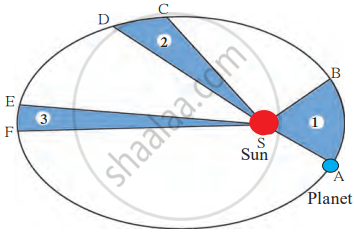
If the area ESF in the given figure is equal to area ASB, what will you infer about EF?
Show that in SI units, the unit of G is Newton m2 kg−2. The value of G was first experimentally measured by Henry Cavendish. In SI units its value is 6.673 × 10⁻¹¹ N m2 kg−2.
Is there a gravitational force between two objects kept on a table or between you and your friend sitting next to you? If yes, why don’t the two move towards each other?
Assuming the acceleration remains constant, how long will Mahendra take to move 1 cm towards Virat?
Think about it
What would happen if there were no gravity?
What would happen if the value of G was twice as large?
Can you tell?
What would be the value of ‘g’ on the surface of the earth if its mass was twice and its radius half of what it is now?
Think about it
Will the direction of the gravitational force change as we go inside the earth?
What will be the value of g at the centre of the earth?
Use your brain power!
Will your weight remain constant as you go above the surface of the earth?
Suppose you are standing on a tall ladder. If your distance from the centre of the earth is 2R, what will be your weight?
Use your brain power!
According to Newton’s law of gravitation, earth’s gravitational force is higher on an object of larger mass. Why doesn’t that object fall down with higher velocity as compared to an object with lower mass?
Balbharati solutions for साइंस एण्ड टेक्नॉलोजी पार्ट १ [अंग्रेजी] कक्षा १० महाराष्ट्र राज्य बोर्ड 1 Gravitation Exercise [Pages 14 - 15]
Study the entries in the following table and rewrite them putting the connected items in a single row.
| I | II | III |
| Mass | m/s2 | Zero at centre |
| Weight | kg | Measure of inertia |
| Acceleration due to gravity | Nm2/kg2 | Same in the entire universe |
| Gravitational constant | N | Depends on height |
Answer the following questions.
What is the difference between the mass and weight of an object?
Will the mass and weight of an object on the earth be same as their values on Mars? Why?
What is the free fall?
What is the acceleration due to gravity?
What is escape velocity?
What is centripetal force?
Write the three laws given by Kepler. How did they help Newton to arrive at the inverse square law of gravity?
A stone is thrown vertically upwards with initial velocity u reaches a height ‘h’ before coming down. Show that the time taken to go up is the same as the time taken to come down.
If the value of g suddenly becomes twice its value, it will become two times more difficult to pull a heavy object along the floor. Why?
Explain why the value of g is zero at the centre of the earth.
Let the period of revolution of a planet at a distance R from a star be T. Prove that if it was at a distance of 2R from the star, its period of revolution will be \[\sqrt{8}\] T.
Solve the following examples.
An object takes 5 s to reach the ground from a height of 5 m on a planet. What is the value of g on the planet?
The radius of planet A is half the radius of planet B. If the mass of A is MA, what must be the mass of B so that the value of g on B is half that of its value on A?
The mass and weight of an object on earth are 5 kg and 49 N respectively. What will be their values on the moon? Assume that the acceleration due to gravity on the moon is 1/6th of that on the earth.
An object thrown vertically upwards reaches a height of 500 m. What was its initial velocity? How long will the object take to come back to the earth? Assume g = 10 m/s2.
A ball falls off a table and reaches the ground in 1 s. Assuming g = 10 m/s2, calculate its speed on reaching the ground and the height of the table.
The masses of the earth and moon are 6 × 1024 kg and 7.4 × 10²² kg, respectively. The distance between them is 3.8 × 10⁵ km. Calculate the gravitational force of attraction between the two?
Use G = 6.7 × 10⁻¹¹ N m2 kg–2
The mass of the earth is 6 × 1024 kg. The distance between the earth and the sun is 1.5 × 10¹¹ m. If the gravitational force between the two is 3.5 × 10²² N, what is the mass of the sun? Use G = 6.7 × 10⁻¹¹ N m2 kg–2
Project:
Take weights of five of your friends. Find out what their weights will be on the moon and the Mars.
Solutions for 1: Gravitation
Balbharati solutions for साइंस एण्ड टेक्नॉलोजी पार्ट १ [अंग्रेजी] कक्षा १० महाराष्ट्र राज्य बोर्ड chapter 1 - Gravitation
Shaalaa.com has the Maharashtra State Board Mathematics साइंस एण्ड टेक्नॉलोजी पार्ट १ [अंग्रेजी] कक्षा १० महाराष्ट्र राज्य बोर्ड Maharashtra State Board solutions in a manner that help students grasp basic concepts better and faster. The detailed, step-by-step solutions will help you understand the concepts better and clarify any confusion. Balbharati solutions for Mathematics साइंस एण्ड टेक्नॉलोजी पार्ट १ [अंग्रेजी] कक्षा १० महाराष्ट्र राज्य बोर्ड Maharashtra State Board 1 (Gravitation) include all questions with answers and detailed explanations. This will clear students' doubts about questions and improve their application skills while preparing for board exams.
Further, we at Shaalaa.com provide such solutions so students can prepare for written exams. Balbharati textbook solutions can be a core help for self-study and provide excellent self-help guidance for students.
Concepts covered in साइंस एण्ड टेक्नॉलोजी पार्ट १ [अंग्रेजी] कक्षा १० महाराष्ट्र राज्य बोर्ड chapter 1 Gravitation are Concept of Gravitation, Kepler’s Laws, Earth’s Gravitational Force, Escape Velocity, Uniform Circular Motion (UCM), Force and Motion, Earth’s Gravitational Acceleration, Mass and Weight, Gravitational Waves, Weightlessness in Space, Law of Orbit or Kepler's First Law, Law of Areas or Kepler's Second Law, Law of Periods or Kepler's Third Law, Centripetal Force, Newton's Universal Law of Gravitation, Free Fall, Gravitational Potential Energy.
Using Balbharati साइंस एण्ड टेक्नॉलोजी पार्ट १ [अंग्रेजी] कक्षा १० महाराष्ट्र राज्य बोर्ड solutions Gravitation exercise by students is an easy way to prepare for the exams, as they involve solutions arranged chapter-wise and also page-wise. The questions involved in Balbharati Solutions are essential questions that can be asked in the final exam. Maximum Maharashtra State Board साइंस एण्ड टेक्नॉलोजी पार्ट १ [अंग्रेजी] कक्षा १० महाराष्ट्र राज्य बोर्ड students prefer Balbharati Textbook Solutions to score more in exams.
Get the free view of Chapter 1, Gravitation साइंस एण्ड टेक्नॉलोजी पार्ट १ [अंग्रेजी] कक्षा १० महाराष्ट्र राज्य बोर्ड additional questions for Mathematics साइंस एण्ड टेक्नॉलोजी पार्ट १ [अंग्रेजी] कक्षा १० महाराष्ट्र राज्य बोर्ड Maharashtra State Board, and you can use Shaalaa.com to keep it handy for your exam preparation.
