Advertisements
Advertisements
प्रश्न
A stone is thrown vertically upwards with initial velocity u reaches a height ‘h’ before coming down. Show that the time taken to go up is the same as the time taken to come down.
Advertisements
उत्तर
We have v = u + at ...(1)
and s = ut + `1/2 "at"^2` ...(2)
∴ s = `("v" - "at")"t" + 1/2"at"^2`
= `"vt" - "at"^2+1/2"at"^2`
∴ `"s" = "vt" - 1/2 "at"^2` ...(3)
As the stone moves upward from (A → B) [AB = h]
S = AB = h, t = t1,
a = − g (retardation)
u = u and v = 0
∴ From Eq. (3), h = 0 − `1/2 (-"g")"t"_1^2`
∴ h = `1/2"gt"_1^2` ...(4)
As the stone moves downward from (B → A)
t = t2, u = 0, s = h and a = g
∴ From Eq. (2), h = `1/2"gt"_2^2` ...(5)
From Eqs. (4) and (5),
`"t"_1^2 = "t"_2^2`
∴ `"t"_1 = "t"_2` (∵ t1, t2 are positive.)
APPEARS IN
संबंधित प्रश्न
State whether the following statement is true or false :
The acceleration due to gravity acting on a freely falling body is directly proportional to the mass of the body.
What do you mean by the term free fall ?
The values of g at six distances A, B, C, D, E and F from the surface of the earth are found to be 3.08 m/s2, 9.23 m/s2, 0.57 m/s2, 7.34 m/s2, 0.30 m/s2 and 1.49 m/s2, respectively.
(a) Arrange these values of g according to the increasing distances from the surface of the earth (keeping the value of g nearest to the surface of the earth first)
(b) If the value of distance F be 10000 km from the surface of the earth, state whether this distance is deep . inside the earth or high up in the sky. Give reason for your answer.
Why does a sharp knife cut objects more effectively than a blunt knife ?
Explain why, a wide steel belt is provided over the wheels of an army tank.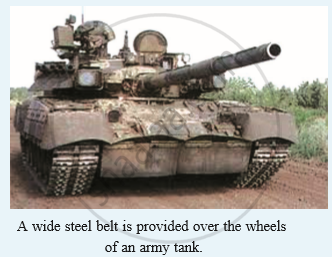
Name the force which pulled the apple off Isaac Newton’s tree.
An object thrown vertically upwards reaches a height of 500 m. What was its initial velocity? How long will the object take to come back to the earth? Assume g = 10 m/s2.
Solve the problem.
If the mass of a planet is eight times the mass of the Earth and its radius is twice the radius of the Earth, what will be the escape velocity for that planet?
The value of acceleration due to gravity of earth :
Choose one or more correct alternatives.
Which of the forces involved in dragging a heavy object on a smooth, horizontal surface, have the same magnitude?
- The horizontal applied force
- gravitational force
- reaction force in vertical direction
- force of friction
A force acts for 10 s on a stationary body of mass 100 kg, after which the force ceases to act. The body moves through a distance of 100 m in the next 5 s. Calculate : The acceleration produced by the force
How is the acccelaration due to gravity on the surface of the earth realted to its mass and radius ?
What is the acceleration due to gravity?
Right or wrong sentence.
Free fall of an object does not depend on the mass of the object.
Write scientific reasons.
The value of gravitational acceleration (g) decreases as we go deep inside the earth.
Write scientific reasons.
When we drop a feather and a stone at the same time from a height the stone reach the earth faster than a feather.
Write scientific reasons.
The value of gravitational acceleration (g) is taken to be -g when studying the motion of an object thrown upwards in a straight line.
Define acceleration due to gravity.
When is free fall possible?
