Advertisements
Advertisements
प्रश्न
Solve the problem.
If the mass of a planet is eight times the mass of the Earth and its radius is twice the radius of the Earth, what will be the escape velocity for that planet?
Advertisements
उत्तर १
Escape velocity for Earth is
Mass of the planet, Mp = 8 `× ` Mass of the Earth (Me)
Radius of the planet, Rp = 2 `× `Radius of the Earth (Re)
Thus, the escape velocity of the planet is
उत्तर २
Given:
Mass of the planet, MP = 8 ME
Radius of the planet, RP = 2 RE
Escape velocity for the Earth, VescE = 11.2 km/s
Escape velocity for the planet, VescP =?
`V_("escP") = sqrt((2"GM"_"p")/("R"_"p")) `
=`sqrt((2"G"(8"M"_"E"))/(2"R"_"E"))`
`=sqrt(8/2 xx (2"GM"_"E")/("R"_"E")`
`= sqrt(8/2) xx sqrt((2"GM"_"E")/"R"_"E")`
`= sqrt(4) xx "V"_("escE")`
∵ `"V"_("escE") = sqrt((2"GM"_"E") /("R"_"E") `
`= 2 xx 11.2`
`"V"_("escP")` = 22.4 Km/s
Escape velocity for the planet = 22.4 km/s
APPEARS IN
संबंधित प्रश्न
Gravitational force acts on all objects in proportion to their masses. Why then, a heavy object does not fall faster than a light object?
A ball thrown up vertically returns to the thrower after 6 s. Find
- the velocity with which it was thrown up,
- the maximum height it reaches, and
- its position after 4 s.
Which force is responsible for the moon revolving round the earth ?
What force is responsible for the earth revolving round the sun ?
Explain what is meant by the equation :
`g= Gxxm/r^2`
where the symbols have their usual meanings.
What do you mean by the term free fall ?
A pressure of 10 Pa acts on an area of 3.0 m2. What is the force acting on the area ? What force will be exerted by the application of same pressure if the area is made one-third ?
What will be the weight of a person on earth, who weighs 9N on the moon?
i) If g = GM/r2 then where will the value of g be high at Goa Beach or on top of Mount Everest?
A force of 15 N acts on a body of mass 2 kg. Calculate the acceleration produced.
A force of 10 N acts on a body of mass 5 kg. Find the acceleration produced.
A force acts for 10 s on a stationary body of mass 100 kg, after which the force ceases to act. The body moves through a distance of 100 m in the next 5 s. Calculate : The acceleration produced by the force
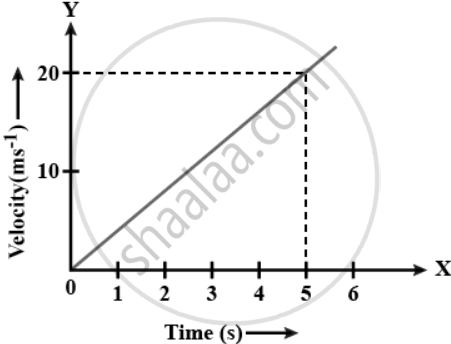
Figure shows the velocity-time graph of a particle of mass 100 g moving in a straight line. Calculate the force acting on the particle.
(Hint : Acceleration = Slope of the v-t graph)
Define the term acceleration due to gravity? Write its S.I. unit.
What force, in newton, your muscles need to apply to hold a mass of 5 kg in your hand? State the assumption.
Explain why:
Objects fall to the earth.
Write scientific reasons.
The value of gravitational acceleration (g) decreases as we go deep inside the earth.
Define acceleration due to gravity.
Write a short note.
Free Fall
When is free fall possible?
