Advertisements
Advertisements
प्रश्न
A force acts for 0.1 s on a body of mass 2.0 kg initially at rest. The force is then withdrawn and the body moves with a velocity of 2 m s-1. Find the magnitude of the force.
Advertisements
उत्तर
Mass, m = 2.0 kg i.e. 2 kg
Initial velocity, u = 0
Final velocity, v = 2 m/s
Time, t = 0.1 s
Acceleration = `"Change in velocity"/"time"`
∴ a = `("v" - "u")/"t"`
∴ a = `(2 - 0)/0.1`
∴ a = 20 ms-2.
Force = Mass × Acceleration
⇒ F = 2 × 20
∴ F = 40 N.
APPEARS IN
संबंधित प्रश्न
Which force is responsible for the moon revolving round the earth ?
Give reason for the following :
The force of gravitation between two cricket balls is extremely small but that between a cricket ball and the earth is extremely large.
Explain why, if a stone held in our hand is released, it falls towards the earth.
Explain why, a wide steel belt is provided over the wheels of an army tank.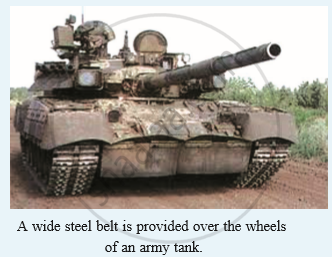
Name the force which wears away two surfaces as they move over one another.
A metal ball of mass 5 kg falls from a height of 490 m. How much time it will take to reach the ground? (g = 9.8 m/s2)
The value of acceleration due to gravity of earth :
What is escape velocity?
The mass of planet ‘X’ is four times that of the earth, and its radius is double the radius of the earth. The escape velocity of a body from the earth is 11.2 × 10³ m/s. Find the escape velocity of a body from the planet ‘X’.
Write a short note.
Escape Velocity
