Advertisements
Advertisements
Question
Solve the problem.
If the mass of a planet is eight times the mass of the Earth and its radius is twice the radius of the Earth, what will be the escape velocity for that planet?
Advertisements
Solution 1
Escape velocity for Earth is
Mass of the planet, Mp = 8 `× ` Mass of the Earth (Me)
Radius of the planet, Rp = 2 `× `Radius of the Earth (Re)
Thus, the escape velocity of the planet is
Solution 2
Given:
Mass of the planet, MP = 8 ME
Radius of the planet, RP = 2 RE
Escape velocity for the Earth, VescE = 11.2 km/s
Escape velocity for the planet, VescP =?
`V_("escP") = sqrt((2"GM"_"p")/("R"_"p")) `
=`sqrt((2"G"(8"M"_"E"))/(2"R"_"E"))`
`=sqrt(8/2 xx (2"GM"_"E")/("R"_"E")`
`= sqrt(8/2) xx sqrt((2"GM"_"E")/"R"_"E")`
`= sqrt(4) xx "V"_("escE")`
∵ `"V"_("escE") = sqrt((2"GM"_"E") /("R"_"E") `
`= 2 xx 11.2`
`"V"_("escP")` = 22.4 Km/s
Escape velocity for the planet = 22.4 km/s
APPEARS IN
RELATED QUESTIONS
Gravitational force acts on all objects in proportion to their masses. Why then, a heavy object does not fall faster than a light object?
A stone is released from the top of a tower of height 19.6 m. Calculate its final velocity just before touching the ground.
Fill in the following blank with suitable word :
The acceleration due to gravity on the moon is about ………………of that on the earth.
During a free fall, will heavier objects accelerate more than lighter ones ?
What is the force of gravity on a body of mass 150 kg lying on the surface of the earth? (Mass of earth = 6 x 1024 kg; Radius of earth = 6.4 x 10⁶ m; G = 6.7 x 10⁻¹¹ Nm2/kg2)
Why does a sharp knife cut objects more effectively than a blunt knife ?
Explain why, a wide steel belt is provided over the wheels of an army tank.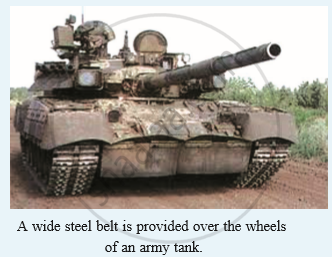
What will be the weight of a person on earth, who weighs 9N on the moon?
The total energy of an object falling freely towards the ground ______.
Figure shows the velocity-time graph of a particle of mass 100 g moving in a straight line. Calculate the force acting on the particle.
(Hint : Acceleration = Slope of the v-t graph)
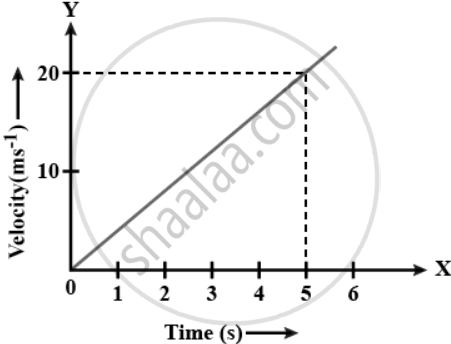
A force causes an acceleration of 10 m s-2 in a body of mass 500 g. What acceleration will be caused by the same force in a body of mass 5 kg?
A body falls freely under gravity from rest and reaches the ground in time t. Write the expression for the height fallen by the body.
In vacuum, all freely falling objects have the same force. Is it true?
Right or wrong sentence.
Free fall of an object does not depend on the mass of the object.
Write scientific reasons.
The value of gravitational acceleration (g) is taken to be -g when studying the motion of an object thrown upwards in a straight line.
The mass and weight of an object on earth are 5 kg and 49 N respectively. What will be their values on the moon? Assume that the acceleration due to gravity on the moon is 1/6th of that on the earth.
When is free fall possible?
