Advertisements
Advertisements
Question
A metal ball of mass 5 kg falls from a height of 490 m. How much time it will take to reach the ground? (g = 9.8 m/s2)
Advertisements
Solution
Given, Mass (M) = 5 kg.
Distance travelled by the ball (s) = 490 m
Initial velocity of the ball (u) = 0
Gravitational acceleration (g) = 9.8 m/s2
Newton's second equation of motion gives
s = `"ut" + 1/2 "gt"^2`
∴ 490 = `0 xx "t" + 1/2 xx 9.8 xx "t"^2` .....[Initial velocity (u) = 0]
⇒ 490 = 4.9 t2
t2 = `490/4.9`
t2 = 100
t = 10 sec.
∴ The ball takes 10 seconds to reach the ground.
APPEARS IN
RELATED QUESTIONS
What force is responsible for the earth revolving round the sun ?
Give reason for the following :
The force of gravitation between two cricket balls is extremely small but that between a cricket ball and the earth is extremely large.
What is the force of gravity on a body of mass 150 kg lying on the surface of the earth? (Mass of earth = 6 x 1024 kg; Radius of earth = 6.4 x 10⁶ m; G = 6.7 x 10⁻¹¹ Nm2/kg2)
Explain why, the tip of a sewing needle is sharp.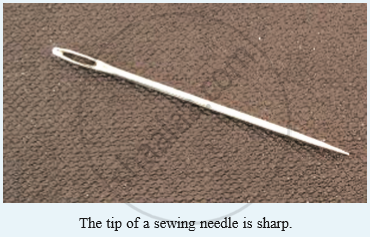
Name the force which wears away two surfaces as they move over one another.
Name the force which stops you falling through the floor.
A stone is thrown vertically upwards with initial velocity u reaches a height ‘h’ before coming down. Show that the time taken to go up is the same as the time taken to come down.
An object thrown vertically upwards reaches a height of 500 m. What was its initial velocity? How long will the object take to come back to the earth? Assume g = 10 m/s2.
For freely falling object we can write the Newton’s second equation of motion as …..
Choose one or more correct alternatives.
Which of the forces involved in dragging a heavy object on a smooth, horizontal surface, have the same magnitude?
- The horizontal applied force
- gravitational force
- reaction force in vertical direction
- force of friction
A force acts for 10 s on a stationary body of mass 100 kg, after which the force ceases to act. The body moves through a distance of 100 m in the next 5 s. Calculate : The acceleration produced by the force
A force causes an acceleration of 10 m s-2 in a body of mass 500 g. What acceleration will be caused by the same force in a body of mass 5 kg?
A force acts for 0.1 s on a body of mass 2.0 kg initially at rest. The force is then withdrawn and the body moves with a velocity of 2 m s-1. Find the magnitude of the force.
What force, in newton, your muscles need to apply to hold a mass of 5 kg in your hand? State the assumption.
What is escape velocity?
State whether the below statement is True or False.
Neglecting air resistance, a body falling freely near the earth's surface has a constant acceleration.
Write the acceleration due to gravity value on the surface of Earth.
When is free fall possible?
