Advertisements
Advertisements
Question
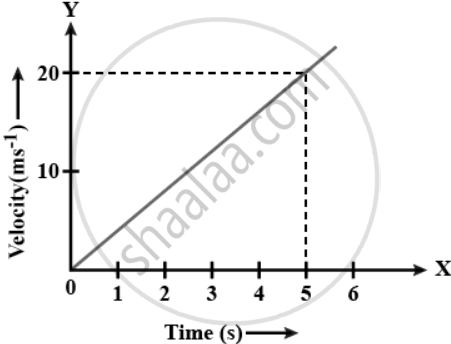
Figure shows the velocity-time graph of a particle of mass 100 g moving in a straight line. Calculate the force acting on the particle.
(Hint : Acceleration = Slope of the v-t graph)
Advertisements
Solution
Given mass, m = 100 g = 0.1 kg.
Slope of a velocity-time graph gives the value of acceleration.
Acceleration = Slope = `20/5` = 4 m/s2.
Force = Mass × Acceleration.
Force = 0.1 × 4 = 0.4 N.
APPEARS IN
RELATED QUESTIONS
A stone is allowed to fall from the top of a tower 100 m high and at the same time another stone is projected vertically upwards from the ground with a velocity of 25 m/s. Calculate when and where the two stones will meet.
A ball thrown up vertically returns to the thrower after 6 s. Find
- the velocity with which it was thrown up,
- the maximum height it reaches, and
- its position after 4 s.
State whether the following statement is true or false :
A falling stone also attracts the earth.
Why does a sharp knife cut objects more effectively than a blunt knife ?
Explain why, a wide steel belt is provided over the wheels of an army tank.
Explain why, the tip of a sewing needle is sharp.
Name the force which stops you falling through the floor.
A stone is thrown vertically upwards with initial velocity u reaches a height ‘h’ before coming down. Show that the time taken to go up is the same as the time taken to come down.
What do you understand by the free fall?
The value of gravitational acceleration (g) is ______.
