Advertisements
Advertisements
प्रश्न
For freely falling object we can write the Newton’s second equation of motion as …..
Advertisements
उत्तर
`s =1/2 g t ^2`.
APPEARS IN
संबंधित प्रश्न
A ball is thrown vertically upwards with a velocity of 49 m/s. Calculate
- the maximum height to which it rises.
- the total time it takes to return to the surface of the earth.
Which force is responsible for the moon revolving round the earth ?
When an object is dropped from a height, it accelerates and falls down. Name the force which accelerates the object.
State whether the following statement is true or false :
The acceleration due to gravity acting on a freely falling body is directly proportional to the mass of the body.
Fill in the following blank with suitable word :
The acceleration due to gravity on the moon is about ………………of that on the earth.
Explain why, a wide steel belt is provided over the wheels of an army tank.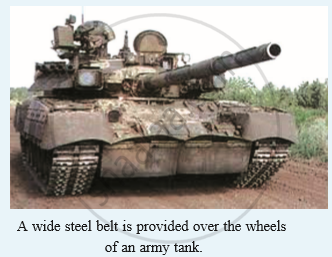
An object thrown vertically upwards reaches a height of 500 m. What was its initial velocity? How long will the object take to come back to the earth? Assume g = 10 m/s2.
Solve the problem.
If the mass of a planet is eight times the mass of the Earth and its radius is twice the radius of the Earth, what will be the escape velocity for that planet?
A metal ball of mass 5 kg falls from a height of 490 m. How much time it will take to reach the ground? (g = 9.8 m/s2)
A force of 10 N acts on a body of mass 5 kg. Find the acceleration produced.
A force causes an acceleration of 10 m s-2 in a body of mass 500 g. What acceleration will be caused by the same force in a body of mass 5 kg?
Define the term acceleration due to gravity? Write its S.I. unit.
How is the acccelaration due to gravity on the surface of the earth realted to its mass and radius ?
How are g and G realated ?
What force, in newton, your muscles need to apply to hold a mass of 5 kg in your hand? State the assumption.
The value of gravitational acceleration (g) is ______.
The free fall of an object is possible only in ______.
Calculate the escape velocity on the surface of the moon given the mass and radius of the moon to be 7.34 × 10²² kg and 1.74 × 10⁶ m respectively.
(Given: G = 6.67 × 10⁻¹¹ Nm2/kg2)
