Advertisements
Advertisements
Question
A car of mass m starts from rest and acquires a velocity along east `v = vhati (v > 0)` in two seconds. Assuming the car moves with uniform acceleration, the force exerted on the car is ______.
Options
`(mv)/2` eastward and is exerted by the car engine.
`(mv)/2` eastward and is due to the friction on the tyres exerted by the road.
more than `(mv)/2` eastward exerted due to the engine and overcomes the friction of the road.
`(mv)/2` exerted by the engine.
Advertisements
Solution
A car of mass m starts from rest and acquires a velocity along east `v = vhati (v > 0)` in two seconds. Assuming the car moves with uniform acceleration, the force exerted on the car is `underline((mv)/2)` eastward and is due to the friction on the tyres exerted by the road.
Explanation:
Given, the mass of the car = m
As the car starts from rest, u = 0
Velocity acquired along east = `vhati`
Duration = t = 2s.
We know that v = u + at
⇒ `vhati = o + a xx 2`
⇒ `s = v/2 hati`
Force, F = ma = `(mv)/2 hati`
Hence, the force acting on the car is `(mv)/2` towards the east. As the external force on the system is only friction hence, the force `(mv)/2` is by friction. Hence, force by the engine is internal force.
APPEARS IN
RELATED QUESTIONS
When a carpet is beaten with a stick, dust comes out of it. Explain.
Give the magnitude and direction of the net force acting on a drop of rain falling down with a constant speed.
The driver of a three-wheeler moving with a speed of 36 km/h sees a child standing in the middle of the road and brings his vehicle to rest in 4.0 s just in time to save the child. What is the average retarding force on the vehicle? The mass of the three-wheeler is 400 kg and the mass of the driver is 65 kg.
Define one newton force.
Is it possible for a particle to describe a curved path if no force acts on it? Does your answer depend on the frame of reference chosen to view the particle?
It is sometimes heard that the inertial frame of reference is only an ideal concept and no such inertial frame actually exists. Comment.
The acceleration of a particle is zero, as measured from an inertial frame of reference. Can we conclude that no force acts on the particle?
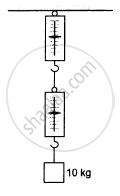
A block of mass 10 kg is suspended from two light spring balances, as shown in the following figure.
Neglect the effect of rotation of the earth. Suppose the earth suddenly stops attracting objects placed near its surface. A person standing on the surface of the earth will.
A reference frame attached to the earth
(a) is an inertial frame by definition
(b) cannot be an inertial frame because the earth is revolving around the sun
(c) is an inertial frame because Newton's laws are applicable in this frame
(d) cannot be an inertial frame because the earth is rotating about its axis.
When a train starts, the head of a standing passenger seems to be pushed backward. Analyse the situation from the ground frame. Does it really go backward? Coming back to the train frame, how do you explain the backward movement of the head on the basis of Newton's laws?
Explain the following :
After alighting from a moving bus , one has to run for some distance in the direction of bus in order to avoid falling .
Give one example each of inertia of rest and inertia of motion.
Give two examples of the following:
Inertia of rest
Differentiate between gravitational mass and inertial mass.
In the above given problem if the lower thread is pulled with a jerk, what happens?
In a legend, the hero-kid kicked a toy pig so that it is projected with a speed greater than that of its cry. If the weight of the toy pig is assumed to be 5 kg and the time of contact 0.01 sec., the force with which the hero-kid kicked him was ______.
(Speed of cry = 330 m/s)
What does inertia measure in an object?
An insect is at the bottom of a hemispherical ditch of radius 1 m. It crawls up the ditch but starts slipping after it is at height h from the bottom. If the coefficient of friction between the ground and the insect is 0.75, then h is ______. (g = 10 ms−2)
An interstellar spacecraft, far away from the influence of any star or planet, is moving at high speed under the influence of fusion rockets (due to the thrust exerted by fusion rockets, the spacecraft is accelerating). Suddenly the engine malfunctions and stops. The spacecraft will ______.
