Advertisements
Advertisements
प्रश्न
A body of mass 0.40 kg moving initially with a constant speed of 10 m s–1 to the north is subject to a constant force of 8.0 N directed towards the south for 30 s. Take the instant the force is applied to be t = 0, the position of the body at that time to be x = 0, and predict its position at t = –5 s, 25 s, 100 s.
Advertisements
उत्तर
Mass of the body, m = 0.40 kg
Initial speed of the body, u = 10 m/s due north
Force acting on the body, F = -8.0 N
Acceleration produced in the body, `a = "F"/"m" = (-8.0)/(0.40) = -20 "m/s"^2`
(i) At t = -5s
Acceleration, a' = 0 and u = 10 m/s
`"S" = "ut" + 1/2 "at"^2`
= 10 × (-5) = -50 m
(ii) At t = 25 s
Acceleration, a'' = -20 m/s2 and u = 10 m/s
S = ut + `1/2` at2
`= 10 xx 25 + 1/2 xx (-20) xx (25)^2`
= 250 + 6250 = -6000 m
(iii) At t = 100 s
For `0 <= t <= 30`
a = –20 m/s2
u = 10 m/s
S1 = ut + `1/2` at2
`= 10 xx 30 + 1/2 xx (-20) xx (30)^2`
= 300 - 9000
= -8700 m
For 30' < t <= 100s
As per the first equation of motion, for t = 30 s, final velocity is given as:
v = u + at
= 10 + (-20) × 30 = -590 m/s
Velocity of the body after 30 s = -590 m/s
For motion between 30 s to 100 s, i.e., in 70 s:
S2 = vt
= -590 × 70 = -41300 m
∴ Total distance, S = s1 + s2 = -8700 - 41300 = -50000 m
APPEARS IN
संबंधित प्रश्न
Two masses 8 kg and 12 kg are connected at the two ends of a light, inextensible string that goes over a frictionless pulley. Find the acceleration of the masses, and the tension in the string when the masses are released.
A batsman deflects a ball by an angle of 45° without changing its initial speed which is equal to 54 km/h. What is the impulse imparted to the ball? (Mass of the ball is 0.15 kg.)
A stone of mass m tied to the end of a string revolves in a vertical circle of radius R. The net forces at the lowest and highest points of the circle directed vertically downwards are: [Choose the correct alternative]
| Lowest Point | Highest Point | |
| a) | mg – T1 | mg + T2 |
| b) | mg + T1 | mg – T2 |
| c) | `mg + T1 –(m_v_1^2)/R` | mg – T2 + (`mv_1^2`)/R |
| d) | `mg – T1 – (mv)/R` | mg + T2 + (mv_1^2)/R |
T1 and v1 denote the tension and speed at the lowest point. T2 and v2 denote corresponding values at the highest point.
A helicopter of mass 1000 kg rises with a vertical acceleration of 15 m s–2. The crew and the passengers weigh 300 kg. Give the magnitude and direction of the
(a) force on the floor by the crew and passengers,
(b) action of the rotor of the helicopter on the surrounding air,
(c) force on the helicopter due to the surrounding air.
A block of mass 15 kg is placed on a long trolley. The coefficient of static friction between the block and the trolley is 0.18. The trolley accelerates from rest with 0.5 ms–2 for 20 s and then moves with uniform velocity. Discuss the motion of the block as viewed by (a) a stationary observer on the ground, (b) an observer moving with the trolley.
When a horse pulls a cart, the force that helps the horse to move forward is the force exerted by
A car accelerates on a horizontal road due to the force exerted by.
In a TV picture tube, electrons are ejected from the cathode with negligible speed and they attain a velocity of 5 × 10⁶ m/s in travelling one centimetre. Assuming straight-line motion, find the constant force exerted on the electrons. The mass of an electron is 9.1 × 10⁻³¹ kg.
A man has fallen into a ditch of width d and two of his friends are slowly pulling him out using a light rope and two fixed pulleys as shown in the following figure. Show that the force (assumed equal for both the friends) exerted by each friend on the road increases as the man moves up. Find the force when the man is at a depth h.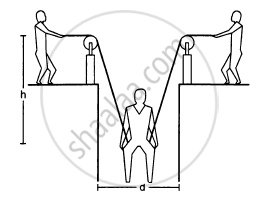
Suppose the ceiling in the previous problem is that of an elevator which is going up with an acceleration of 2.0 m/s2. Find the elongation.
State the magnitude and direction of the force of gravity acting on the body of mass 5 kg. Take g = 9.8 m s-2.
Name the physical entity used for quantifying the motion of a body.
A stone is thrown vertically upward with a velocity of 9.8 m/s. When will it reach the ground?
A ball is thrown vertically downward with an initial velocity of 10 m/s. What is its speed 1 s later and 2 s later?
A metre scale is moving with uniform velocity. This implies ______.
A hockey player is moving northward and suddenly turns westward with the same speed to avoid an opponent. The force that acts on the player is ______.
According to Newton's Second Law of Motion, what quantity is directly proportional to the applied force?
Why is catching a slow-moving ball easier than catching a fast-moving ball?
